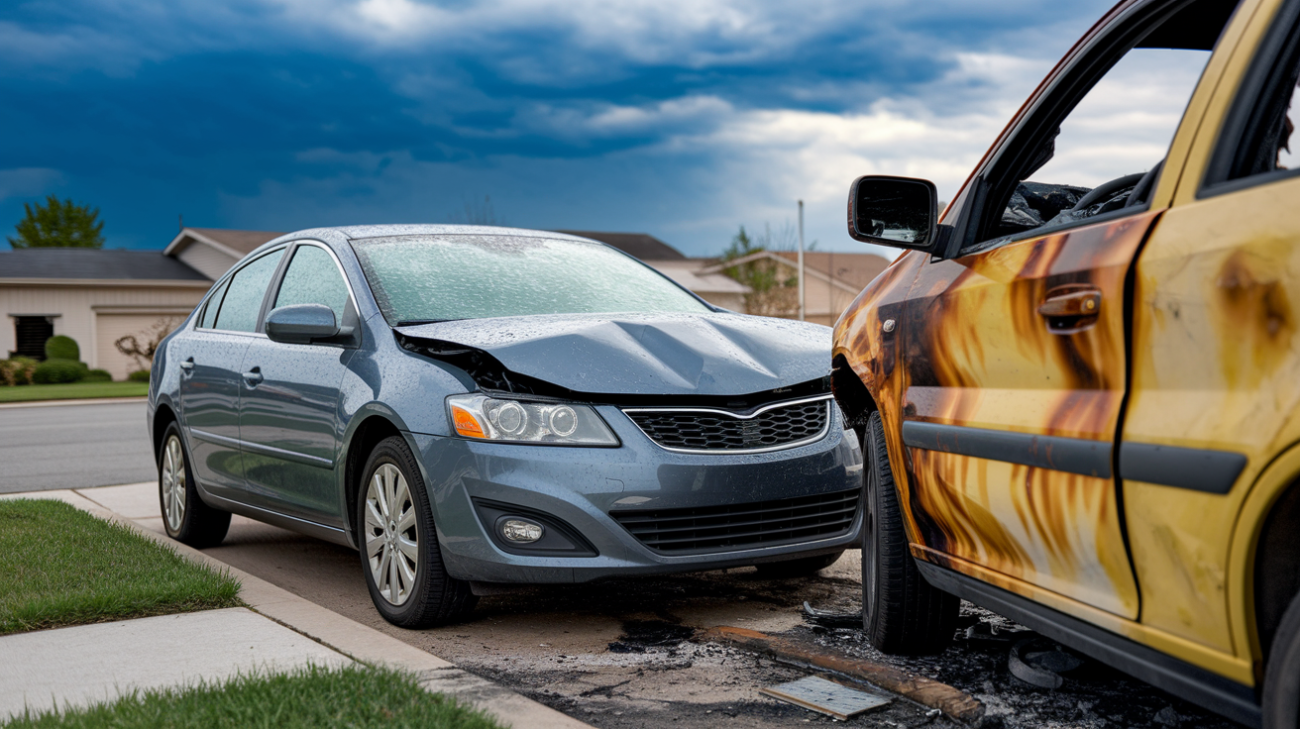
Yes, full coverage in every U.S. State does list hail under the comprehensive side of the policy. That portion pays for weather strikes, including golf-ball sized ice in Denver, sheet-ice storms throughout Dallas, or surprise spring hail bursts in Atlanta.
You pay the fixed deductible, then the insurer covers body-shop repairs or totals the car if dents exceed its value. Continue reading to learn how claims work and how to keep rates low.
Understanding Hail’s Impact

Hail is hard ice that falls from violent storms, striking stationary or mobile vehicles, often resulting in significant damage. Hailstones can range from pea to grapefruit size and strike at speeds up to 120 mph. Common issues include dents, cracked windshields, chipped paint, and broken mirrors, which can lead to costly hail damage repairs if not covered by comprehensive car insurance.
The Obvious Dents
Walk the car immediately after the storm passes and inspect each panel for circular dents. Circle each one with a dry-erase marker so you don’t lose count for the claim. Take pictures with a quarter or ruler next to the dent. Adjusters appreciate precise size.
Begin with the hood, roof, and trunk. Those large dents determine whether or not a car is totaled when the bill exceeds $2,500.
The Hidden Damage
Poke your head under the hood and check for dented heat shields or cracked plastic bits that will rattle later. Finger along windshield edges. Hairline splits begin here and creep across the glass next month.
Roll all windows and sunroof up and down. Concealed bends can pinch seals and induce leaks. Peek inside door frames for miniature folds that rust as soon as the paint peels.
The Value Loss
Pull a complimentary Carfax and record the pre-storm trade-in value. Unrepaired hail drops that total 10 to 30 percent.
Find out from the adjuster if it pays “actual cash value” (what you would get today) or “replacement cost” (enough to buy a similar car). The difference could be in the thousands.
Save each repair bill. Buyers believe a folder of paid invoices more than they believe a story.
If you live in hail alley, Dallas or Lubbock for example, full coverage is inexpensive compared to a $6,000 roof-skin job.
Garage spot saves you from most of this grief. If the storm traps you on I-35, slide under an overpass until it passes.
One claim might not increase your rate, but two claims in three years makes you risky. When dents only cost a few hundred bucks, paying cash keeps the claim off your sheet.
Does Full Coverage Cover Hail Damage?

Yes, if you have comprehensive car insurance coverage in your policy under the declarations page, hail damage is covered under that line. Liability coverage plans waive it, leaving you responsible for the entire repair costs.
The Comprehensive Component
Comprehensive car insurance coverage protects against hail damage, theft, and even incidents like a raccoon damaging your seats. Since banks require this coverage for financed vehicles, making a hail damage car insurance claim typically won’t cause your premiums to rise.
The Deductible’s Role
Choose a $1,000 deductible and your monthly bill dips. One Denver storm can have you facing a $3,200 body shop tab. Just stash that deductible in its own savings bucket and the car goes right to the shop instead of sitting in the driveway as you’re scrambling.
One storm, one deductible, albeit if hail bashes the roof twice before dawn! Saving $180 a year on premium takes almost six years to top a single typical hail claim of $2,700.
The Policy Exclusions
Just forget to make one payment and the policy lapses. Any ice balls that land the next day are yours alone. Drive into purple skies after the National Weather Service pings your phone and the adjuster could label it ‘willful damage.’
Last spring’s pre-existing dents are out, and those golf clubs you left on the back seat aren’t covered. Home or renters insurance gets those.
The Total Loss Scenario
When estimates exceed 75% of the car’s actual cash value—determined by state regulation—the title becomes salvage. You get market value less deductible less what the yard would pay for the hulk.
If you still want the dented ride, most insurers allow you to buy it back at scrap value minus a little. You keep the difference and live with the golf-ball finish.
The Fire Damage Comparison
Fire claims are lumped into that same comprehensive bucket as hail, not collision. Flames melt wiring quick, so cars typically total at lower percentages than hail.
One twist is that some fire departments mail a $500 service invoice later; storms send no such bill.
Filing Your Hail Claim

Act fast. The majority of carriers mark late claims after 48 hours, so call the 24-hour line the same day the storm stops. Having your policy number, the street where the car sat, and the storm’s start and end times at the ready, the rep opens the file as you chat.
Request the claim number, the adjuster’s name, and if your policy includes rental reimbursement; some LA drivers forget they added that perk on last renewal.
Document Everything
- 20 close-up pictures of every dent, along with one wide shot of the entire panel.
- NOAA hail map for your ZIP, saved as PDF.
- Quick note: “6:15 p.m., 1-inch stones, parked at 1247 S. Cloverdale Ave, witness: neighbor Maya.”
- Upload it all to one drive folder “5/3 hail” so a lost phone can’t kill your evidence.
Body shops in L.A. will provide you a free inspection if you’re unsure whether the dings are hail damage. In addition, print out their one-page check-sheet and keep it in your folder.
Contact Your Insurer
Launch the app, hit ‘File a Claim’ and input precise mileage. Adjusters compare it to your previous oil-change sticker to identify pre-existing dents. Talk about any door dings you acquired at Trader Joe’s last month.
Concealing them results in arguments down the line. Ask the rep to email a timeline. Most insurers send an adjuster within three business days. Store the adjuster’s cell; you can text if 405 traffic is going to make you late to the inspection.
Get An Estimate
Cruise the carrier’s express lane at Koreatown’s certified center. They scan dents with LED boards in 15 minutes.
If no express lane, pop into a couple of body shops on Pico Blvd for written bids. One came in at $2,500. Another came in at $3,100 on the same Prius.
Cross check numbers against the adjuster’s sheet. If his falls to $1,800, inquire, as sometimes they overlook roof dings spotted under shop lights.
Negotiate it yourself: Ask if the shop uses paintless dent repair so your factory paint remains intact. PDR costs between $75 and $125 for a dime-size ding compared to $600 for repainting a panel.
Choose A Repair Shop
Select a shop on the insurer’s “preferred” list. They pay direct and lifetime workmanship is included. Peek in the bay. You want LED dent boards and glue-pull tabs made for hail, not standard body filler tools.
Make sure they will file supplemental claims if hidden damage pops up once the headliner drops. Some L.A. Shops eat that cost themselves. Obtain a definite finish date to reserve your rental return. Body backlogs after major San Fernando Valley storms can add an additional two weeks to completion.
Will A Claim Raise Rates?

Most states inform insurers that they cannot increase your premium for one hail claim under your comprehensive car insurance coverage. For example, if a storm dents your hood, you absorb the $500 deductible, and the insurance company cuts the body shop a $3,200 check. Your next invoice still lists the same six-month rate you had before. This is because state rules treat hail damage as an act of nature, not driver error, so the claim sits in a ‘no-fault’ bucket that is off-limits to surcharges.
Surcharges typically appear when you make a claim. For instance, if you run a red light in Denver and clip a pickup, your collision claim can add 20 to 40 percent to the premium at renewal. However, comprehensive hail claims do not reside in that bucket. One shopper in Kansas experienced her bill remaining flat after a $4,800 roof-skin repair, but it jumped $180 per year after she rear-ended someone six months later. The two claims were coded differently, and only the at-fault crash impacted the premium.
If you file three hail damage claims in thirty-six months, the narrative can shift. While insurers don’t raise the rate, they may refuse to renew your policy. A Texas driver cashed in on the spring storms of 2019, 2021, and 2022—each costing less than $3,000. On the fourth renewal, the carrier mailed a non-renewal notice since too many acts of God still indicate high risk, regardless of surcharges. Agents refer to this as ‘frequency exposure,’ which is legal in all states.
Although that first claim keeps quiet on the bill, shop quotes annually anyway. Some insurance providers silently strip “claim-free” discounts worth 5–15% as soon as any comprehensive loss touches your CLUE report. A married couple in Omaha watched their $940 yearly premium slide to $1,020 after a single hail damage car insurance claim, with no surcharge, just the disappearing discount.
The actual comparison of three new quotes ended up with a smaller regional insurer at $880 with identical coverage. One claim might not raise rates, but two or three within a short window definitely can; insurers consider total claims count along with type and amount. A $600 hood ding probably won’t shift next year’s bill, but a $9,000 total-roof replacement plus two more quick claims adds up.
Carriers evaluate various factors such as credit tier, garaging zip code, and mileage, so that final quote is a mix of many moving parts, ultimately affecting your auto insurance policy.
The “Totaled by Hail” Dilemma

When the adjuster declares it “totaled by hail,” your next step is math, not drama. The payout sheet lists two numbers: what the car was worth the minute before the storm, and what the dented shell is worth now. If you still owe on the loan, the bank gets paid first, and the rest, if any, comes to you. Understanding your auto insurance policy can help you navigate this process effectively.
Signing the title over closes the claim in around 10 days, and you’re back to shopping. They allow you to keep the car in every state, but you have to send the title back to DMV so they can stamp “salvage” on it. You still receive the proceeds less the salvage tender. That is the money you’ll spend on glass, tires, and whatever else keeps it street-legal. If you have comprehensive car insurance coverage, it may help with some of these costs.
A 2018 Denver Subaru Crosstrek with $9,800 hood, roof, and glass damage might have a $14,200 ACV and a $2,900 salvage bid. Take the $11,300 check, replace a $1,100 windshield, and you still get to drive a golf ball of a car that runs great. Knowing the repair costs ahead of time can help you make better financial decisions.
Get the salvage number from the adjuster before you make up your mind. That number is established by auction bids in your county, so it fluctuates weekly. Take it off the settlement to find out your true budget. If you require just glass and lamps to make it through inspection, you can keep the margin. This insight can be invaluable when planning your next steps after hail damage.
If the roof skin leaks and airbags are blown, that difference shrinks quickly. One Oklahoma owner kept a 2020 F-150. The salvage bid was $6,400 and the payout was $22,100, so he netted $15,700. With a new windshield costing $380 and a rear window costing $420, he was left with $14,900 to put in the bank or spend on other needs. This scenario highlights the importance of understanding the insurance coverage you have.
All states write their own rules on rebuilt titles after hail. Kansas allows you to continue driving on the salvage tag if the car is more than ten years old with no additional inspection required. In Illinois, you have to repair all safety glass and lights, then pass a state police test and pay a $94 fee before the DMV provides a rebuilt title. Familiarizing yourself with these regulations can save you time and effort.
Missouri adds a theft check at a licensed garage; bypass it and there is no plates renewal. When you sell later, Carfax flags the rebuilt brand and trade-in bids drop by 20 to 40 percent. For private buyers, they will still bite if the glass is clear and the doors open; price it low and show the repair receipts. Keeping thorough records of your repairs can help when dealing with potential buyers.
Insurers see that same rebuilt stamp when you request comp coverage later. Progressive and Geico will gladly sell you liability but drop comprehensive once hail pops up in the VIN history. State Farm might maintain comp but increase the deductible to $1,000 or $2,500 and reduce payouts by an additional 10%. Understanding how these changes can affect your car insurance coverage is crucial.
Shop around every renewal. Regional carriers such as American Family in Colorado or Farm Bureau in Texas will sometimes even add comp back on after one clean year with photos. Exploring different insurance options can lead to better coverage and lower premiums over time.
How to Prevent Hail Damage

A $2,500 body-shop bill is the quickest way to give a damn about hail damage. Pea-size ice sounds adorable until it comes at you at 70 mph. Four-inch chunks of rock-hard ice can cave a roof in. The good news is that most hits are avoidable with a few cheap habits that can help protect your vehicle from significant damage.
Keep an eye on your phone. All weather apps send “severe thunderstorm” notifications moments before hail begins. When the ping hits, get the car to the closest covered garage. In L.A., that could be a mall structure in Culver City, a bank lot in Glendale, or the Metro parking deck at Universal City. Thirty minutes of meter money is better than weeks without your ride, especially when considering the potential repair costs of hail damage.
Leave a hail blanket in the trunk from March through June. The best ones are those three-layer pads sewn for cars, with a nylon outside, foam core, and soft liner, which run about ninety bucks on Amazon and roll up like a yoga mat. Drape it over the hood and roof, secure the clips inside the doors, and you’ve preserved the paint and glass, minimizing the need for hail damage repairs.
A simple tarp is of some assistance, but it is the padded style that halts those dents. No garage at home? Purchase a $180 pop-up carport at Home Depot. Two of us can bolt the steel frame together in an hour. The roof panel snaps on like a patio cover, providing comprehensive car insurance coverage against hailstorms.
It rests on skids, so municipal code seldom gives a damn. If you rent, recess four eye hooks in the driveway edge and tie the legs down. When hail looms, slide the car underneath and pull the side curtains shut. It folds flat against the back fence the remainder of the year.
Zombie on the 405 when ice starts ricocheting? Don’t keep driving! Pull off at the first underpass, halt behind the crash line, and remain in your vehicle. The bridge deck blocks the majority of stones, but passing traffic flings them laterally into your doors, increasing the likelihood of damage.
If no underpass is nearby, tilt the car so the windshield faces away from the wind. Side glass is less expensive to replace. Pile on the layers if you crave additional defense! Inflatable hail covers provide an air gap, but they take five minutes to inflate and are only useful if you park in the street and have warning time.
Padded blankets work in 30 seconds and fit in a Civic trunk. In short, watch the sky, stash a blanket, and borrow a roof anywhere you can to avoid a hail damage car insurance claim.
Conclusion
Hail punches hard. A solid full-coverage plan punches back. Know your deductible, take pictures immediately, and call your insurance company before the next storm comes around. Garage parking, thick blankets, or an inexpensive carport can cut future dings and dents and save money in your wallet. Shop around every year. Rates move fast in L.A. A ten-minute quote could save you hundreds. Drive safe, park smart, and always keep that claims app on your phone. Want to secure smarter coverage or lower your bill? Dust off your policy, click on the link below, and get a free quote today.
Frequently Asked Questions
Is hail damage covered under full coverage in California?
Yes. Your comprehensive car insurance coverage covers hail damage, including dents, cracked glass, and ruined paint after a hailstorm, minus your selected deductible.
How long do I have to file a hail claim in L.A.?
Most California carriers will want you to call within 30 days of the hailstorm. Snap dated photos and call the minute the sky clears to keep within the car insurance claim window.
Will a hail claim jack up my premium?
Not typically. Comprehensive car insurance coverage claims are ‘no-fault,’ so insurance providers seldom surcharge. You’ll only see a hike if you’ve stacked several hail damage claims in a single year.
Can my car be totaled by pea-sized hail?
If repair estimates for hail damage exceed 70 to 75 percent of your car’s actual cash value, the adjuster can total it, especially in the case of significant damage.
Do I pay my deductible before the shop fixes my car?
Yes, you pay the comprehensive deductible directly to the body shop for hail damage repairs, and the auto insurance provider covers the rest. Choose a shop in your insurer’s network for quicker approval.