Auto liability coverage limits determination is picking how much your insurer will pay if you cause injuries or property damages in a crash.
In the U.S., state minimums differ, for example, 15/30/5 in California and 25/50/25 in Texas, but actual expenses tend to be much greater. Limits depend on your assets, miles driven to work, local medical and repair costs, and risk tolerance.
To establish intelligent limits, balance court awards, wage loss, and multi-car claims. The next section dissects steps and examples.
Why State Minimums Fail
State minimums are set to keep drivers legal, not protected. Standard minimums, usually $25,000 per person and $50,000 per accident, trail increasing medical costs, pricier cars, and bigger verdicts. After a hard crash, deficiencies come down on you, imperiling savings, income, and assets.
Minimums ignore uninsured and underinsured motorist needs, and a few states allow drivers to waive add-ons such as medical payments, further increasing gaps. There is self-insurance or surety bonds, but these aren’t workable options for most families.
Item | Typical State Minimum (BI/PD) | Average Serious Crash Cost |
|---|---|---|
Bodily injury per person | $25,000 | $60,000–$150,000+ hospital/rehab |
Bodily injury per accident | $50,000 | $120,000–$300,000+ multi-injury |
Property damage | $10,000–$25,000 | $12,000–$45,000+ modern vehicles |
Legal defense | Included but limited | $20,000–$100,000+ through trial |
The Asset Gap
State minimums cease paying when claims exceed your policy. The balance is your mess. Courts can garnish wages, place liens, or order the sale of assets to satisfy judgments.
If you own a home in L.A. With equity, a 401(k), or a brokerage account, one high-cost claim can reach those, too.
- Home equity and secondary properties
- Bank accounts and taxable investments
- Future wages and freelance income
- Vehicles, jewelry, collectibles
- Business interests and rental income
High-net-worth and dual-income households have greater exposure. Some discover too late that $50,000 per accident does not extend to multiple injured parties.
The Injury Gap
Medical bills climb faster than inflation. A trip to the ER with an image can easily go five figures. Surgeries, rehab, and long-term care drive costs well beyond $100,000. Minimum bodily injury limits almost never correspond to real-world bills in significant injuries.
Once thresholds are reached, suppliers and victims turn to you. That can translate into payment plans, liens or lawsuits. Think about it, UM/UIM coverage, usually not mandated or kept low, is what covers you when the at-fault motorist has minimums.
Typical injury costs:
- Ambulance and ER: $2,000–$10,000
- Surgery and inpatient stay: $30,000–$100,000+
- Rehab and follow-up: $5,000–$50,000+
- Long-term care/lost income: highly variable, often six figures
The Lawsuit Gap
Attorney fees, discovery, expert witnesses and trial costs can scorch those limits before a verdict. Pain and suffering, lost wages and future care awards frequently dwarf minimum coverage. Low limits make you sue bait.
Think in terms of defense, not just damages. Higher limits decrease the likelihood that the plaintiff goes after your assets and can increase settlement leverage.
Typical lawsuit-related costs not covered by minimums:
- Plaintiff attorney contingency fees
- Defense beyond carrier’s duty if limits exhaust
- Expert witness and accident reconstruction
- Court costs, mediation, depositions, transcripts
- Pre- and post-judgment interest and large verdict gaps
Determining Your Liability Limits

Begin by taking a comprehensive inventory of your assets, your net worth and your level of risk on the road. Determining Your Liability Limits State minimums do not often come close to real accident costs. Strive to beat them, align limits across auto, home, and umbrella policies, and leverage a simple worksheet to sum assets, income risk and exposure.
Liability limits, which comprise bodily injury and property damage, and insurers provide either split limits like 100/300/100 or a combined single limit that allows one cap per accident.
1. Your Assets
List what a court could reach: home equity, other real estate, vehicles, savings, brokerage accounts, business interests, and high-value personal items. Liquid assets that can be garnished are included. This count is your starting point for how much coverage to purchase.
Higher-value assets demand higher limits. For a lot of people, 100/300/100 is a reasonable minimum. Property damage of $50,000 tends to cover one high-end car or a few cars in a pile-up. If your net worth is substantial, consider 250/500/100 or perhaps a higher CSL.
Review limits as your assets increase. New home equity, a bigger portfolio, or a paid-off car all increase risk. Revisit after major life changes or once a year.
Identify which assets are most at risk in a big crash. Non-retirement accounts and home equity rank high. Then tailor limits accordingly and look to an umbrella policy to expand protection beyond auto and home.
2. Your State
Check your state minimums against real claim sizes in your area. In most states, minimums aren’t going to cover a serious injury or a two-car pileup on a busy freeway.
Certain states require higher minimums for bodily injury or property damage. Other states tack on no-fault or PIP that alters how claims get paid but does not supplant strong liability.
Be aware of local rules that shift thresholds or lawsuits. Then build a quick chart: state minimums on one side and your recommended split limits or CSL on the other, so you can see the gap.
3. Your Risk
Score your risk: miles driven, commute routes, accident and ticket history, and weather patterns. Dense LA traffic at rush hour is a different risk than light rural miles.
Young or inexperienced drivers increase family exposure. Previous at-fault losses do as well. Families with teen drivers usually increase to 250/500/100 or a strong CSL.
Remember to contemplate the kind and worth of cars you operate. Hitting a $120,000 car can quickly exceed low PD limits.
Create a brief risk factor list to steer limits and assist in pricing umbrella coverage.
4. Your Future
Consider income and ambitions. A judgment can go beyond present assets and instead go after future wages, so set your limits with your income trajectory in mind.
As your career advances or you purchase a home, raise limits and supplement with an umbrella policy if necessary. ‘Map’ milestones, such as marriage, kids, and business launch, and set reminders to revisit coverage every time.
Use a worksheet: assets plus future income at risk plus driving exposure equals split limits of 100/300/100, 250/500/100 or a CSL and match to home and umbrella.
How Liability Limits Apply
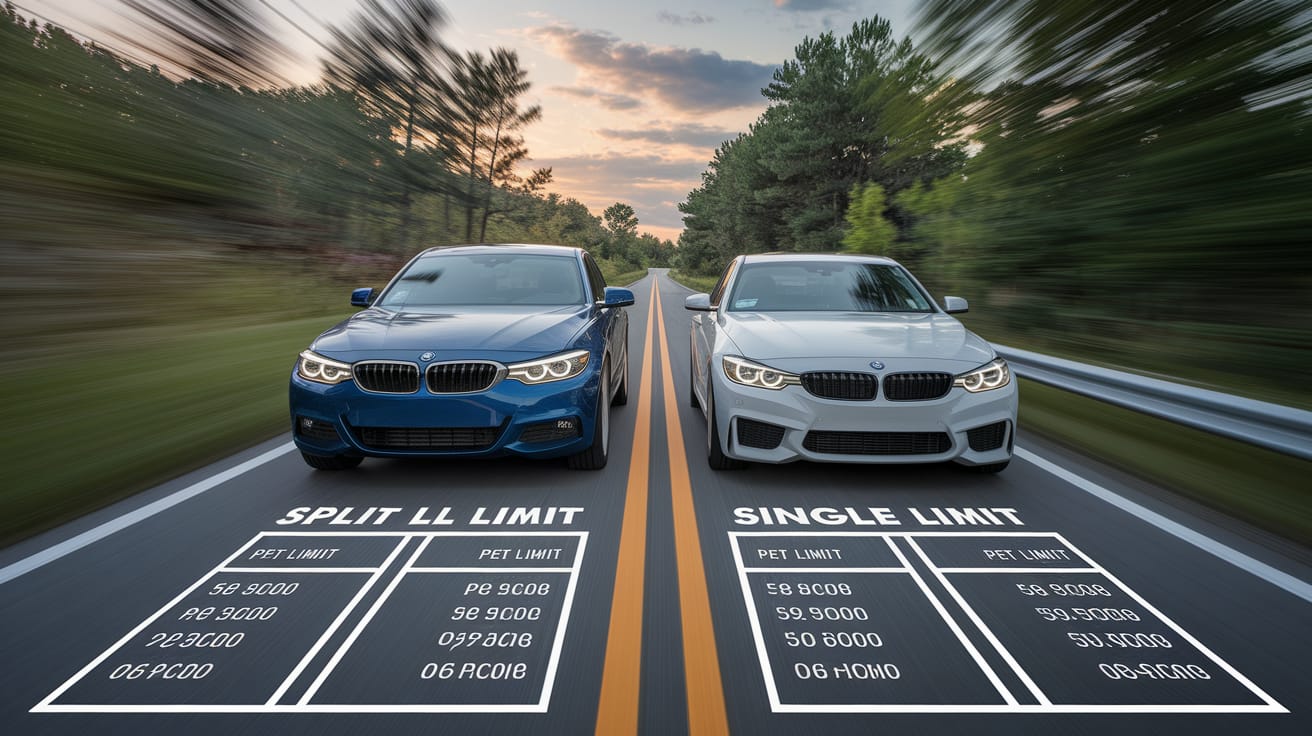
Liability limits are what your auto policy pays others for the injuries and property damage you cause. Policies have either split limits or a single limit. Split limits present three figures, like $100,000 per individual, $300,000 per accident, and $100,000 for property damage.
A combined single limit provides one pot, say $300,000, that applies to both bodily injury and property damage in an accident. Split limits cap each bucket. A single limit is more flexible but can be drained by one category quickly.
Example table comparing structures:
- Split limits: Separate caps for per person, per accident, and property damage are predictable, but less flexible.
- Single limit: One shared cap for all damages per accident. There is flexible distribution but there is a danger of being used up early by one demand.
Real world math helps. Given split limits of $30,000, $60,000, and $15,000 and a three-injury crash with medical bills of $40,000, $25,000, and $10,000, payouts top out at $30,000 for the first person, then $25,000 and $5,000 to stay under the $60,000 total.
Ten thousand dollars remain unpaid for the first person. With a $300,000 single limit, all three bills and property damage can tap the same $300,000 until it is depleted.
Per Person
Or, in how liability limits work, the per person limit is the most paid for bodily injury to one person you injure. If your policy shows $30,000 per person and a victim’s bills are $85,000, insurance pays $30,000. You are responsible for the remainder.
Courts can garnish wages or attach assets for the difference. Look at your declarations page for the precise per person amount and whether it is stacked or non-stacked, and if defense costs are inside or outside limits.
Most consultants recommend at least $100,000 per individual to minimize risk.
Scenarios that strain per person payouts:
- A cyclist with surgery and rehab exceeding $100,000.
- A rideshare passenger with long hospital stay.
- A pedestrian with traumatic injuries and follow-up care.
Per Accident
The per accident limit is the amount for all bodily injuries in a single wreck. It doesn’t scale with your headcount. In a multi-vehicle pileup, this cap runs out quickly.
Match your per accident cap against realistic multi-party claims in your locale. Losses are pushed higher by medical inflation and higher verdicts. A minimum of $60,000 per accident can be thin when three ER visits and imaging are involved.
Example: With $300,000 per accident, four injured people with $90,000, $60,000, $50,000, and $40,000 in bills total $240,000, leaving $60,000 for more treatment. With $60,000 per accident, only a fraction gets paid.
Property Damage
Property damage liability pays to repair or replace other people’s vehicles, buildings, fences, street signs, or utility equipment. Low limits leave gaps.
$5,000 or $15,000 minimums still exist in some places and won’t cover a single high-end bumper-to-bumper repair. Think about increasing limits to reflect the vehicles you encounter every day. Luxury SUVs, EVs, and congested roads increase the typical claim amount.
Common scenarios and ballpark costs:
- Rear-end a luxury SUV: $9,000–$22,000.
- Total an older sedan: $6,000–$10,000.
- Hit two cars: $18,000–$40,000 combined.
- Damage a storefront or pole: $5,000–$25,000.
Note on old minimums: Some regions still use figures dating back to 1967, like $15,000 per person, $30,000 per accident, and $5,000 property damage. Most drivers go for at least $100,000 per person and $300,000 per accident with higher property damage, often $100,000, to more adequately cover today’s expenses.
The Insurer’s Calculation

Insurance companies employ their own proprietary calculations to set premiums and recommended liability limits. The calculations factor in who you are, how and where you drive, and what a claim might cost. The idea is to calculate the probability of a crash and the dollar impact should it occur, then translate that into limits and cost.
Consider any carrier advice, but vet it against your risk, assets, and worst-case-loss comfort.
Statistical Models
Carriers rely on actuarial data to estimate how often and how seriously accidents occur and then convert those findings into recommended limits and rate levels. They bucket drivers into risk categories based on age, driving record, vehicle type, mileage per year, commute pattern, and history of claims.
Longer daily drives, congested traffic, and a lot of highway miles increase anticipated loss. Clean records often open up good-driver discounts. It’s those models that inform both the dollar limits and the premium.
Greater recommended limits, for example, 100/300/100, which means $100,000 per person, $300,000 per accident, and $100,000 for property damage, are pricier but broaden the buffer. Insurers look to future earnings potential since a judgment can extend beyond current assets and garnish future income.
Risk categories can impact eligibility for higher limits or umbrella options. If you’re in a more serious severity class, a carrier may apply stronger limits or price lower limits more aggressively. Insist the agent provide a plain-English explanation of how model inputs, such as tickets, mileage, and claims, shifted your rate and limit guidance.
Regional Data
Local conditions count. In LA and the other big cities, crash rates, hospital bills, and repair bills cost a lot, so the recommended limits are higher. Car density, high-value cars, and pricey body shops drive property damage needs well past bare minimums.
A luxury SUV pileup can blow through $100,000 quickly. Insurers account for local claims experience, such as injury settlements or litigation patterns. Weather spikes, freeway downpours, along with theft and hit-and-run counts fuel the model.
Build your own view: check state DOT crash stats, city Vision Zero reports, and insurer loss maps where available. If your ‘hood leans toward high-value autos, think higher property damage or an umbrella.
Economic Trends
Inflation raises medical bills, parts, and labor that can eat away at today’s limits in a matter of years. Check limits annually and after significant market shifts. Financial strain can push up UM rates, so it’s smart to have more liability and matching UM/UIM.
Follow local hospital charge indexes, body shop estimates and court award trends. Higher limits increase premiums, but they shield assets and future income. Many specialists throw out limits at or above net worth.
For many drivers, 100/300/100 is a smart floor, not a ceiling.
Beyond The Standard Policy

Standard auto liability coverage limits often cap at 250/500/100 or a combined single limit (CSL). For many drivers, that ceiling is fine. However, for high earners, business owners, and homeowners with equity, it may not suffice. The goal is to close gaps by raising auto insurance limits, adding uninsured motorist coverage, and considering an umbrella policy to shield both assets and future earnings.
Umbrella Policies
Umbrella policies provide liability coverage on top of your auto and home policies. They kick in after your standard limits and can absorb big verdicts from catastrophic crashes, multi-car accidents, or pedestrian claims. They typically begin at $1 million and are often less expensive than you might think for the coverage they provide.
Set limits by totaling your assets and potential income. A judgment can attach to wages, bonuses, or business income, so factor in future earnings, too. Most choose auto at 250/500/100 with a $1 to $5 million umbrella to fashion a customized ‘financial moat,’ particularly in higher-cost regions and with teenage drivers in the mix.
With 250/500/100, a $900,000 injury claim can exceed your BI per-accident cap. A $1 million umbrella would cover the overflow. Typically, increasing to higher limits costs around $150 to $200 more per year, which provides a lot of peace of mind.
Table: How Umbrella Layers Over Existing Limits
- Primary auto liability: 250/500/100 or CSL
- Claim amount: $1,200,000 bodily injury, single accident
- Primary pays up to 500,000 per accident or CSL cap.
- Umbrella pays: Remaining $700,000 (up to umbrella limit)
Uninsured Motorist
Uninsured motorist coverage pays when an at-fault driver is without insurance. It can encompass bodily injury and, in select states, property damage. With so many drivers remaining uninsured, UM is your backstop.
Review your state’s UM regulations and loss costs. In areas with high medical bills and high traffic density, higher UM is smart. Try to match your liability limits so your own policy can step up.
Crucial scenarios:
- Hit-and-run where the driver can’t be found.
- For an at-fault driver whose coverage had lapsed following a serious injury crash.
- Pedestrian or cyclist struck by an uninsured driver.
Underinsured Motorist
UM coverage covers the hole when the at-fault driver’s limits are too low. Match UIM limits to your liability to stay whole. Make sure you have both BI and, where available, property damage UIM.
Examples:
- Other driver 25/50 and your hospital bill by itself is $140,000. UIM fills the gap.
- Multi-passenger injuries are above the other driver’s per-accident cap. UIM avoids out of pocket misery.
- Think CSL if you want one pot of money to use where needed.
Purchasing minimums is money Russian roulette. For those with assets, aim for 250,000/500,000/100,000 or higher plus a $1 million umbrella.
The Future of Limit Setting

Auto liability limits are not going to stand still. New car tech, court awards, and medical bills keep redefining what ‘enough liability coverage’ means in the US. Drivers in L.A. encounter prohibitively expensive repair and more costly bodily injury liability coverage, not to mention dense traffic risk. All these factors may push both insurers and lawmakers toward higher recommended auto liability coverage limits than today’s common 100/300/100 benchmarks.
Predict that evolving vehicle technology, litigation trends, and medical costs will drive higher recommended liability limits.
These next-gen driver-assist systems reduce certain types of crashes but increase repair costs owing to expensive sensors, cameras, and calibration. Meanwhile, injury case verdicts, often referred to as social inflation, have been on the rise as have hospital charges. Combined, the probable trajectory is upward pressure on limits.
For numerous homes, going from state minimums to a minimum of 100/300/100 or even 250/500/250 will be the new norm. For drivers who rideshare, drive congested freeways, or have newer EVs with costly body parts, a $1 million-plus umbrella policy could be the new standard.
Advise staying informed about legislative changes that may alter minimum insurance requirements.
States establish minimums, and those change. Lawmakers examine injury data, repair costs, and insurer solvency and can increase BI or property damage minimums to keep up with actual crash costs. Whilst some states are reexamining rating factors like credit scores, with a handful already banning or restricting them, this may shift how insurers price limits and options suggested.
Track bills at your state’s insurance department site and monitor for insurer notices of statutory changes.
Encourage regular reassessment of liability coverage limits to adapt to changing risk environments.
Recheck limits yearly or at major life changes: buying a home, adding a teen driver, starting a business, or logging more miles. Match limits to assets at risk and your exposure pattern. For example, for a dense metro where you move, a luxury car you drive or street-side parking, increase property damage.
If medical inflation in your area is high, boost bodily injury. Take actual quotes and compare steps – one hundred/three hundred/one hundred to two hundred fifty/five hundred/two hundred fifty and price an umbrella add-on.
Recommend monitoring industry innovations, such as telematics, that could impact future limit recommendations.
Insurers now rely on AI and analytics to customize risk, and telematics programs monitor speed, braking, time of day, and phone usage. The future of limit setting involves more dynamic, personalized limits that change with behavior, miles, or season, along with flexible limit bundles you can customize to budget and need.
These transitions can improve precision but bring up fair-use concerns about prejudice and lucidity. As self-driving spreads, blame could migrate toward vehicular and property damage claims, pushing more pressure on liability coverage decisions.
Conclusion
Make your boundaries with real life in mind. State floors in CA can feel low when a wreck piles up bills. Medical care is expensive. Vehicles are more expensive to repair. Court claims accumulate quickly. A split limit, such as 100/300/100, fits most LA drivers. High earners, lengthy commutes, or teenage drivers might require additional coverage. Umbrella policies add a large margin of safety for a reasonable cost.
To test your number quickly, add up your net worth, your road risk and your budget. Then compare at 100/300/100 and 250/500/100. Observe the price jump per tier. Inquire about an umbrella at one million.
Need a sanity check for your limits? Connect with a local agent, discuss your figures, and receive a transparent comparative quote now.
Frequently Asked Questions
What are California’s minimum auto liability limits, and why are they not enough?
California’s minimum liability coverage limits are $15,000 per person, $30,000 per accident for bodily injury liability coverage, and $5,000 for property damage liability. These insurance limits often fall short of covering hospital bills or even minor car repairs in LA, leading to out-of-pocket expenses.
How do I decide on the right liability limits for driving in Los Angeles?
Go with 100/300/100 as your starting point for adequate car insurance coverage. Consider your assets, income, commute, and traffic exposure. Higher insurance limits safeguard savings, home equity, and future wages. In LA’s congested roads and expensive repair environment, many people opt for 250/500/100 or a $1 million umbrella.
How do split limits like 100/300/100 actually apply in a crash?
Split limits set a cap on payouts for car insurance coverage on a per person and per accident basis. With 100/300/100, one person can receive up to $100,000 in bodily injury liability coverage, and all together no more than $300,000, with property damage liability coverage up to $100,000. Any costs exceeding these insurance limits are your responsibility.
Do insurers in California use my credit score to set liability premiums?
AUTO INS IN CA: Insurers can’t use credit scores for auto insurance rates. They primarily consider your driving record, years licensed, annual mileage, type of vehicle, and ZIP code. In Los Angeles, coverage limits and congestion are significant factors in pricing.
What’s the difference between split limits and a combined single limit (CSL)?
Split limits in auto insurance coverage are divided between bodily injury liability coverage per person, per accident, and property damage liability coverage. A combined single limit rolls them into a single pot, say $500,000 overall, offering greater flexibility for coverage needs if losses tend toward property damage or a single injured party.
Should I add uninsured/underinsured motorist (UM/UIM) coverage in LA?
Yes. California has a lot of underinsured motorists. Underinsured motorist coverage assists in covering your injuries when the at-fault driver lacks enough liability coverage. Match your UM/UIM to your liability insurance limits for stronger protection, particularly with LA medical bills and extended commutes.
When do I need a personal umbrella policy in California?
Think of an umbrella if you have a home, savings, or high income, or if you drive a lot in LA. Umbrella policies provide liability insurance coverage limits ranging from one million to five million dollars, which is essential for financial protection against lawsuits exceeding your auto insurance coverage or home insurance limits.