
Table of Contents
- General vs Professional Liability Insurance: Core Differences
- General Liability Insurance Examples and Real-World Scenarios
- Errors and Omissions Insurance: Professional Negligence Protection
- Professional Liability Insurance Cost: Pricing Factors and Comparisons
- Do You Need Both Types of Liability Insurance?
- Claims Process Walkthrough and Legal Defense Costs
- Business Owner’s Policy (BOP) and Bundling Options
- Conclusion: Protecting Your Business with the Right Coverage
Last Updated: June 20, 2026
Most business owners assume one liability policy covers everything. That assumption is what makes general vs professional liability insurance one of the most misunderstood distinctions in commercial insurance. At Covera, we see this confusion regularly, and it costs businesses real money when a claim falls through the coverage gap between the two. Below, we’ll show you exactly how these policies differ, which industries need each one, and how to decide whether you need both.
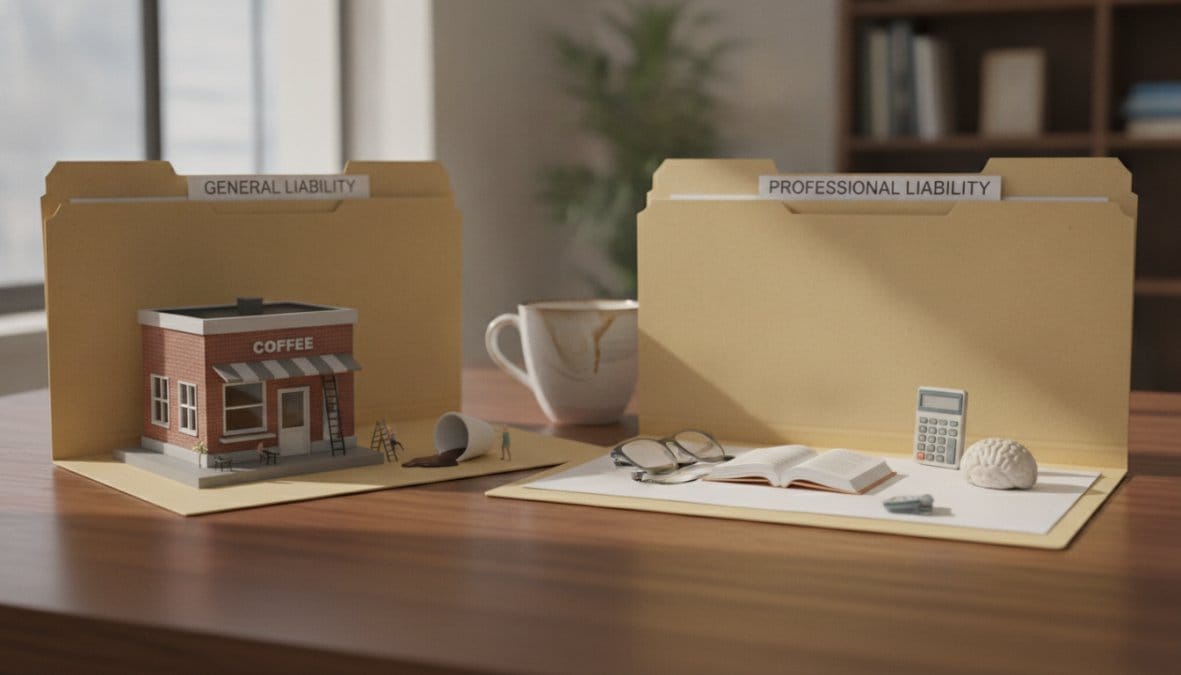
General liability addresses physical and reputational harm. Professional liability addresses financial harm caused by your expertise, advice, or services. No single standard policy covers both.
General vs Professional Liability Insurance: Core Differences
General liability insurance protects businesses from third-party claims involving bodily injury, property damage, personal injury, and advertising injury. Professional liability insurance protects service-based businesses from claims arising out of professional negligence, errors and omissions, or failure to deliver promised results.
A client who trips on a wet floor in your office and breaks their wrist is a general liability claim. A client who loses money because you gave them flawed financial advice is a professional liability claim. Both are third-party claims, but the underlying risk categories are entirely different.
| Feature | General Liability | Professional Liability |
|---|---|---|
| Covers bodily injury | Yes | No |
| Covers property damage | Yes | No |
| Covers professional negligence | No | Yes |
| Covers errors and omissions | No | Yes |
| Covers advertising injury | Yes | No |
| Covers financial loss from bad advice | No | Yes |
| Common name | GL, CGL | E&O, Malpractice |
| Required by contracts | Often | Often (for service providers) |
What General Liability Insurance Covers
General liability covers bodily injury to third parties, damage to third-party property, personal injury (such as defamation), and advertising injury (such as copyright infringement in marketing materials). It also typically includes legal defense costs, which can be substantial even when a claim is ultimately dismissed.
GL policies are designed around physical and reputational risks. A contractor who breaks a client’s window, a retailer whose customer slips on a wet floor, or a marketing agency whose ad copy infringes a competitor’s trademark all fall under general liability.
What Professional Liability Insurance Covers
Professional liability insurance covers claims that your professional services, advice, or work product caused a client financial harm. The policy responds when a client alleges you made an error, omitted critical information, acted negligently, or failed to meet the professional standard of care.
This coverage is also called errors and omissions (E&O) insurance in most service industries, and malpractice insurance in healthcare and legal fields.
Professional liability policies are typically written on a “claims-made” basis, meaning the policy in force when the claim is filed covers the loss, not the policy in force when the work was done. This matters if you change carriers or let a policy lapse.
General Liability Insurance Examples and Real-World Scenarios
Bodily Injury and Property Damage Claims
A client visits your office and slips on ice near the entrance, fracturing their ankle. Your GL policy covers their medical expenses, lost wages, and legal costs if they sue. A plumber accidentally ruptures a pipe while working at a client’s home, flooding the kitchen. The repair costs are covered under the plumber’s GL policy.
Slip and Fall, Advertising Injury, and Third-Party Claims
Slip and fall claims are the most common general liability scenario for retail and hospitality businesses. Advertising injury covers claims that your ad campaign infringes a competitor’s trademark or that a social media post defames another company. Personal injury claims cover reputational harm such as libel, slander, or wrongful eviction.
Errors and Omissions Insurance: Professional Negligence Protection
Professional liability is where general liability stops. Once the alleged harm is financial or tied to the quality of your professional judgment, you need a separate policy.
When Professional Judgment Fails
A management consultant recommends a restructuring plan that a client implements. The results are worse than projected, and the client loses revenue. They sue, claiming the consultant’s advice was negligent. A GL policy will not respond. Professional liability insurance will.
The same logic applies to architects who miss a code requirement, accountants who file an incorrect return, and software developers whose code contains a critical bug. In each case, the harm is financial and stems from professional work.
Many small business owners assume their general liability policy covers professional errors because it covers “everything.” It does not. Discovering that gap after a claim is filed is one of the most expensive mistakes a service-based business can make.
Malpractice, Breach of Contract, and Financial Loss Coverage
Malpractice is the healthcare and legal industry’s term for professional liability. A surgeon who performs the wrong procedure, a lawyer who misses a filing deadline, or a therapist who breaches confidentiality all face malpractice claims covered under professional liability.
Professional liability policies often cover breach of contract when the breach is tied to a failure of professional services, though coverage varies by policy language. Financial loss coverage is the core of professional liability, the policy responds when a client demonstrates that your professional services directly caused them quantifiable financial harm.
Professional Liability Insurance Cost: Pricing Factors and Comparisons
Professional liability insurance cost varies based on industry, revenue, claims history, and coverage limits.
Premium Calculations and Deductible Considerations
Insurers calculate professional liability premiums based on the nature of professional services provided, annual revenue, years in business, prior claims history, coverage limits selected, and the deductible. Higher coverage limits increase premiums. Choosing a higher deductible reduces the annual premium but increases out-of-pocket costs when a claim occurs.
General liability premiums follow a similar structure, though physical risk factors like business location, foot traffic, and the nature of work performed drive GL pricing.
Risk Assessment and Underwriting for Service-Based Businesses
Underwriting for professional liability is more subjective than for general liability because the risks are less tangible. An insurer underwriting a cybersecurity consultant’s E&O policy assesses the quality of the consultant’s work processes, client contracts, and professional credentials.
Service-based businesses can improve their underwriting profile by maintaining thorough client contracts, documenting work processes, carrying appropriate professional credentials, and demonstrating a clean claims history. According to the U.S. Small Business Administration’s business insurance guidance, maintaining clear service agreements is one of the most effective risk management steps a small business can take.
Do You Need Both Types of Liability Insurance?
Most service-based businesses need both policies. A business that provides professional services AND has a physical location where clients visit needs both. A freelance copywriter who works entirely remotely may need professional liability but has minimal general liability exposure. A retail store needs GL but likely not professional liability.
 documents side by side on a desk, laptop open with a coffee cup nearby, warm natural light from a window](https://covera.blog/wp-content/uploads/2026/06/general-vs-professional-liability-insurance-key-differences-content-1-1781967093.jpg)
Industry-Specific Risk Mapping and Contractual Requirements
| Industry | Primary GL Exposure | Primary PL Exposure | Typically Requires Both? |
|---|---|---|---|
| IT Consultants | Low-moderate | High (errors, data breaches) | Yes |
| Contractors/Trades | High (bodily injury, property) | Moderate (design errors) | Yes |
| Healthcare | Moderate (premises) | High (malpractice) | Yes |
| Accountants/CPAs | Low | High (financial errors) | Often |
| Retail Businesses | High (slip and fall) | Low | Rarely |
| Marketing Agencies | Moderate (advertising injury) | High (campaign results) | Yes |
| Real Estate Agents | Low-moderate | High (transaction errors) | Yes |
Many clients and government contracts require both GL and professional liability before work begins. A certificate of insurance demonstrating both coverages is often a condition of doing business.
Decision Framework: Who Needs What Coverage
Use this framework to determine your coverage needs:
- Does your business have a physical location where clients, customers, or vendors visit? If yes, you need general liability.
- Do you provide advice, professional services, or expertise for a fee? If yes, you need professional liability.
- Could a client claim financial harm from the quality of your work or advice? If yes, professional liability is essential.
- Do your client contracts require proof of either or both coverages? Check your agreements.
- Do you have employees who work on client premises? If yes, general liability is critical.
- Do you work in healthcare, law, finance, or architecture? Regulatory requirements likely mandate professional liability.
If you checked boxes in both columns, you need both policies.
Claims Process Walkthrough and Legal Defense Costs
Filing a liability claim is straightforward, but the timeline and process differ between general and professional liability policies.
Filing a Claim and Settlement Expectations
For general liability claims, the process begins when a third party notifies you of an injury or property damage. You notify your insurer promptly, provide documentation of the incident, and cooperate with the insurer’s investigation. The insurer assigns a claims adjuster who evaluates liability and damages.
For professional liability claims, the trigger is usually a written demand or lawsuit from a client alleging professional negligence. Because these policies are claims-made, the date the claim is first made is the operative date for coverage purposes. Notify your insurer immediately upon receiving any written demand.
Settlement timelines vary. Straightforward GL claims can resolve in weeks. Complex professional liability disputes can take years.
Litigation Support and Policyholder Responsibilities
Both policy types include legal defense costs as a covered benefit, but the structure differs. Many GL policies provide defense costs in addition to the coverage limit. Many professional liability policies include defense costs within the limit, meaning legal fees reduce the amount available for settlement or judgment.
The policyholder’s responsibilities include cooperating fully with the insurer’s chosen defense counsel, providing all requested documentation, and not making admissions of liability without insurer consent.
Legal defense costs can exceed the actual settlement amount in many professional liability cases. Always check whether your policy covers defense costs inside or outside the coverage limit before purchasing.
Business Owner’s Policy (BOP) and Bundling Options
A Business Owner’s Policy (BOP) bundles general liability and commercial property insurance into a single policy at a reduced combined premium. It is designed for small to mid-sized businesses and is one of the most cost-effective ways to secure foundational coverage.
A standard BOP does not include professional liability. Businesses that need E&O or malpractice coverage must add it separately, either as an endorsement to the BOP or as a standalone policy. Some carriers offer BOP packages that allow professional liability to be added as a rider.
Providers like NEXT Insurance offer bundled coverage options combining GL, professional liability, and workers’ compensation in a single platform. Thimble provides on-demand coverage flexibility for project-based or seasonal businesses. Hiscox specializes in professional services firms requiring higher coverage limits. Simply Business operates as a brokerage, allowing businesses to compare quotes from multiple carriers simultaneously. According to the National Association of Insurance Commissioners’ small business insurance resources, comparing multiple carriers before purchasing is one of the most reliable ways to reduce commercial insurance costs.
The right bundling strategy depends on your business structure. A solo consultant with no physical office may find a standalone professional liability policy sufficient. A five-person firm with a client-facing office will likely benefit from a BOP plus a professional liability endorsement.
Frequently Asked Questions
What is the main difference between general and professional liability insurance?
General liability insurance covers bodily injury, property damage, and third-party claims from physical accidents (like slip and fall incidents). Professional liability insurance, also called errors and omissions insurance, covers financial loss from professional negligence, mistakes in service delivery, or breach of contract. General liability protects against what happens at your location; professional liability protects against what you do for clients.
Do I need both general and professional liability insurance?
Most service-based businesses and professionals need both. General liability covers physical risks and third-party bodily injury claims, while professional liability covers abstract risks like professional judgment errors and malpractice. Many contracts require both types. Your industry, client requirements, and risk profile determine necessity. Consult your contractual obligations and risk assessment to decide.
What does errors and omissions insurance cover that general liability doesn’t?
Errors and omissions insurance covers professional negligence, mistakes in judgment, failure to deliver services, and financial losses resulting from your professional work. It covers breach of contract claims and malpractice allegations. General liability doesn’t cover these abstract risks, it only covers physical damage or bodily injury. This distinction is critical for consultants, accountants, architects, and other service professionals.
How much does professional liability insurance cost, and what affects the premium?
Professional liability insurance costs vary widely based on industry, coverage limits, deductible, years in business, claims history, and annual revenue. Premiums typically range from a few hundred to several thousand dollars annually. Risk assessment and underwriting evaluate your specific profession and exposure. Service-based businesses with higher financial stakes pay more. Get quotes from multiple carriers to compare pricing for your situation.
Choosing between general and professional liability coverage is rarely an either/or decision for service-based businesses. Most need both, and the gap between the two policies is where expensive claims fall through. Covera provides detailed policy comparisons, coverage breakdowns, and expert guidance across all commercial insurance types to help you identify exactly what your business needs. Explore Covera’s business insurance resources and get the clarity to make an informed coverage decision.