
Table of Contents
- Best Small Business Insurance Providers 2024: Quick Comparison
- 1. The Hartford: Industry-Tailored Coverage & Claims Excellence
- 2. Hiscox: Digital-First Professional Liability Specialist
- 3. NEXT Insurance: Fast Online Coverage for Modern Small Businesses
- 4. Travelers: Comprehensive Commercial Solutions with Risk Management
- 5. Chubb: Premium Coverage for Complex Business Risks
- 6. Liberty Mutual: Flexible Multi-Policy Bundling Options
- 7. Nationwide: All-in-One Business Owner’s Policy (BOP) Coverage
Last Updated: June 23, 2026
Choosing the right coverage is one of the most consequential decisions a small business owner will make. At Covera, we’ve broken down the top providers by coverage type, claims transparency, and industry fit so you can skip the guesswork. Most business owners overpay for generic coverage or underbuy on the policies that matter most for their specific risk profile. Below, we’ll show you exactly which providers win for which situations, what each policy type actually covers, and the factors that drive your premiums up or down.
According to [U.S. Small Business Administration guidance on business insurance(/get-business-insurance-quotes-today/) | sba.gov], a single uninsured liability claim can financially devastate a small business.
Best Small Business Insurance Providers 2024: Quick Comparison
The best small business insurance providers span many coverage specialties, pricing structures, and service models. Here’s a direct comparison to help you orient before diving into the details.
Provider Comparison Table
| Provider | Best For | Standout Feature | Policy Types | Quote Process |
|---|---|---|---|---|
| The Hartford | Industry-tailored coverage | Specialized BOP by sector | GL, BOP, Workers’ Comp, Cyber | Agent or online |
| Hiscox | Freelancers and consultants | Instant E&O/professional liability | Professional liability, GL, BOP | Fully online |
| NEXT Insurance | Speed and self-service | Instant COI generation | GL, Professional, Commercial Auto | 100% digital |
| Travelers | Established SMBs | Risk control services | GL, Commercial Property, Cyber | Agent-based |
| Chubb | Complex or high-value risks | High-limit underwriting | Specialty, GL, Property, Cyber | Agent-based |
| Liberty Mutual | Multi-policy bundling | Local agent + digital portal | BOP, Commercial Auto, GL | Hybrid |
| Nationwide | All-in-one BOP | Independent agent network | BOP, GL, Workers’ Comp | Agent or online |
Every provider listed is quote-based, so actual premiums depend on your industry classification (NAICS codes), annual revenue, payroll size, and claims history.
1. The Hartford: Industry-Tailored Coverage and Claims Excellence
The Hartford earns its reputation as the go-to carrier for small businesses needing coverage built around a specific industry, not a generic template. Its Business Owner’s Policy is customizable by sector, meaning a contractor gets different endorsements than a retail shop owner.
What separates The Hartford is its claims management platform. Policyholders can file, track, and manage claims digitally, cutting the friction that makes claims processes painful at other carriers.
Best for: Small businesses in construction, healthcare services, retail, and manufacturing that need tailored coverage and dependable claims support.
Pros:
- Customizable BOP with industry-specific endorsements
- Highly rated digital claims management platform
- Extensive workers’ compensation experience across high-risk sectors
Cons:
- Pricing requires a quote; not transparently available online
- Complex policies require working through an agent
The Hartford offers data breach and cyber liability endorsements as add-ons to its BOP. Add these at policy inception rather than later, as retroactive cyber coverage is limited.
Coverage highlights: General liability, commercial property, workers’ compensation, professional liability, commercial auto, cyber liability, and business interruption coverage.
2. Hiscox: Digital-First Professional Liability Specialist
Professional service firms get underserved by most carriers. Hiscox built its small business product specifically for that gap.
For consultants, freelancers, IT contractors, and marketing agencies, errors and omissions (E&O) insurance is critical. A client claim that your advice caused financial harm can trigger legal costs exceeding your annual revenue. Hiscox specializes in professional liability coverage at prices fitting small professional operations.
The digital experience is genuinely fast. You can get a quote, bind coverage, and receive your certificate of insurance in a single session, a practical advantage for independent contractors needing proof of insurance to land contracts.
Best for: Freelancers, consultants, IT professionals, marketing agencies, and firms where professional advice is the core deliverable.
Pros:
- Instant online quotes and same-day policy issuance
- Strong errors and omissions coverage with flexible payment plans
- Purpose-built for independent contractors and sole proprietors
Cons:
- Less competitive for businesses with significant commercial property exposure
- Coverage limits may not scale for larger, complex operations
Coverage highlights: Professional liability (E&O), general liability, business owner’s policy, cyber liability, and commercial auto.
3. NEXT Insurance: Fast Online Coverage for Modern Small Businesses
Speed is NEXT Insurance’s entire value proposition, and it delivers.
Small business owners needing coverage today will find NEXT’s 100% digital application process impressive. From quote to bound policy to certificate of insurance generation, the entire process happens online without a phone call or agent meeting. For a sole proprietor who just landed a client requiring proof of general liability coverage, NEXT removes every barrier.
The mobile app lets policyholders manage coverage, update information, and share certificates of insurance directly from their phone. Contractors regularly needing to provide COIs to general contractors can do it on-site in seconds.
Best for: Small business owners who prioritize speed, digital self-service, and straightforward coverage needs.
Pros:
- Instant certificate of insurance generation
- Fully online application and policy management
- Bundling options for general liability and professional liability
Cons:
- Limited capacity for complex, high-risk commercial enterprises
- Less suited for businesses needing highly customized coverage structures
NEXT Insurance works well for straightforward risks. If your business operates heavy equipment, employs more than 20 people, or has significant commercial property exposure, you’ll likely hit coverage limits requiring a traditional carrier.
Coverage highlights: General liability, professional liability, commercial auto, workers’ compensation, and tools and equipment coverage.
4. Travelers: Comprehensive Commercial Solutions with Risk Management
Travelers brings something most digital-first insurers can’t: genuine risk management infrastructure.
Beyond writing policies, Travelers offers risk control services that help businesses prevent losses before they happen. For an established small business with physical operations, employees, and real property exposure, that proactive approach has tangible value. Fewer incidents mean fewer claims, which means premiums stay manageable at renewal.
According to AM Best financial strength ratings for insurance carriers, Travelers consistently holds an A++ rating, the highest available designation.
Best for: Established small-to-mid-sized businesses with physical locations, employees, and complex coverage needs.
Pros:
- Extensive commercial property and liability coverage options
- Risk control services that actively help reduce loss exposure
- Strong financial stability and global underwriting capacity
Cons:
- More complex to navigate than digital-only providers
- Agent-dependent process can slow quote and binding timelines
Coverage highlights: Commercial property, general liability, workers’ compensation, cyber liability, commercial auto, and business interruption insurance.
5. Chubb: Premium Coverage for Complex Business Risks
Chubb is not the right fit for every small business. For the ones it does fit, there’s no better option.
The carrier specializes in high-limit coverage for businesses with complex risk profiles: technology companies, life sciences firms, financial services operations, and any business where a single claim could reach seven figures. Chubb’s underwriting capabilities are genuinely specialized, meaning your policy reflects your industry’s actual risks.
Claims handling quality at Chubb is consistently cited as a differentiator. Higher premiums buy faster, more thorough claims resolution and access to specialized adjusters who understand your industry.
Best for: Businesses with complex risks, high-value assets, or specialized coverage needs where premium service justifies higher cost.
Pros:
- Exceptional financial strength and global underwriting capacity
- High-limit coverage options for complex or high-value risks
- Superior claims handling with specialized industry expertise
Cons:
- Premiums are generally higher than budget-focused or mid-market carriers
- May exceed what a straightforward retail or service business needs
Coverage highlights: Specialty liability, general liability, commercial property, cyber liability, professional liability, and directors and officers (D&O) coverage.
6. Liberty Mutual: Flexible Multi-Policy Bundling Options
The strongest argument for Liberty Mutual is bundling. Businesses needing multiple policy types, general liability, commercial auto, and commercial property, can consolidate under one carrier and reduce overall premium through bundled policies.
Liberty Mutual’s hybrid model combines a digital policy management portal with access to local agents, suiting business owners who want online convenience without losing the option to talk to someone who knows their account.
The national footprint means local agent availability is strong in most markets, which matters for businesses preferring a relationship-based insurance experience.
Best for: Small businesses managing multiple coverage types that benefit from bundling discounts and prefer a mix of digital and agent-based service.
Pros:
- Strong bundling options that reduce overall premium costs
- National presence with local agent support in most markets
- Online portal for policy management and document access
Cons:
- Customer service quality varies by region and individual agent
- Less specialized than niche carriers for specific industry risks
Bundling your general liability, commercial property, and commercial auto policies with a single carrier typically reduces your total premium compared to buying each policy separately. Always ask for a bundled quote before committing to separate carriers.
Coverage highlights: Business owner’s policy (BOP), commercial auto, general liability, commercial property, workers’ compensation, and umbrella coverage.
7. Nationwide: All-in-One Business Owner’s Policy (BOP) Coverage
Nationwide’s core strength is accessibility. Through a wide network of independent agents, small businesses across most industries can access a comprehensive Business Owner’s Policy that bundles general liability and commercial property into a single, manageable policy.
A Business Owner’s Policy combines general liability (protecting against third-party bodily injury and property damage claims) and commercial property (covering your business assets, equipment, and inventory) into one policy with one premium and one deductible. Nationwide’s BOP is well-regarded for its breadth and the quality of its independent agent network.
Best for: Small businesses looking for reliable, all-in-one coverage through a trusted carrier with strong agent relationships.
Pros:
- Comprehensive BOP that covers most small business core risks
- Wide availability through independent agents nationwide
- Solid reputation for general commercial coverage and claims handling
Cons:
- Some policyholders report challenges when underwriting criteria change at renewal
- Less suited for highly specialized or complex commercial risks
Coverage highlights: Business owner’s policy, general liability, commercial property, workers’ compensation, commercial auto, and farm and agriculture coverage.
Types of Small Business Insurance Coverage Explained
Small business insurance is not a single product. It’s a stack of policies, each addressing a different category of risk. Understanding what each type covers is essential to identifying gaps in your protection.
| Coverage Type | What It Covers | Who Needs It |
|---|---|---|
| General Liability | Third-party bodily injury, property damage, advertising injury | Nearly every business |
| Professional Liability (E&O) | Claims arising from professional advice or services | Consultants, agencies, IT firms |
| Commercial Property | Business assets, equipment, inventory, building | Businesses with physical assets |
| Workers’ Compensation | Employee injuries and occupational illness | Required in most states with employees |
| Business Interruption | Lost income during covered shutdowns | Businesses with physical locations |
| Cyber Liability | Data breaches, ransomware, notification costs | Any business handling customer data |
| Commercial Auto | Business vehicle accidents and damage | Businesses using vehicles for work |
General liability is the baseline. It protects against third-party claims for bodily injury or property damage from your business operations. Most clients, landlords, and general contractors require a certificate of insurance showing active general liability coverage.
Professional liability (errors and omissions) covers claims that your professional advice or services caused a client financial harm. It’s distinct from general liability and essential for any business where expertise is the product.
Workers’ compensation requirements vary by state, but most states mandate coverage once you hire even one employee. As documented in National Council on Compensation Insurance workers’ comp state requirements, licensing requirements and mandatory coverage thresholds differ significantly across jurisdictions.
How to Choose the Right Small Business Insurance Provider
The right provider depends on three variables: your industry risk profile, your coverage needs, and how you prefer to manage your policies.
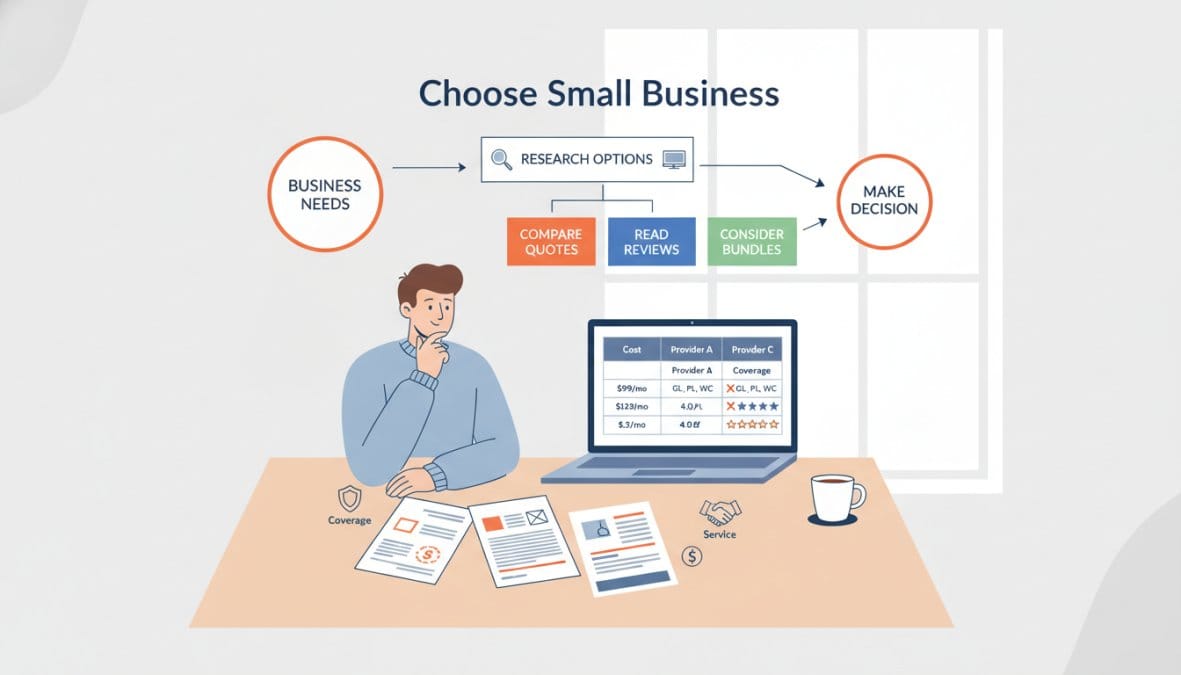
Start with your industry classification. Carriers underwrite risk differently by NAICS code, and some specialize in sectors others avoid entirely. A technology consulting firm has fundamentally different risk exposure than a landscaping company, and the best carrier for one is rarely the best for the other.
Here’s a practical framework for evaluating providers:
- Coverage fit: Does the carrier offer the specific policy types your industry requires, including any specialty endorsements?
- Claims process transparency: Can you file and track claims digitally? What’s the average resolution timeline for your policy type?
- Financial stability ratings: Check AM Best or S&P ratings. An insurer with a weak financial rating is a liability, not an asset.
- Premium vs. coverage limits: The cheapest policy is not the best policy. Compare coverage limits and deductibles, not just premiums.
- Post-purchase policy management: Can you update coverage, add endorsements, or generate certificates of insurance without calling an agent every time?
The post-purchase experience is where many carriers fall short. Businesses that grow quickly need to adjust coverage frequently. A carrier with a clunky policy management process creates real operational friction.
Frequently Asked Questions
What is the most important insurance coverage for a small business?
General liability insurance is typically the most critical coverage for small businesses, as it protects against bodily injury and property damage claims. However, the best small business insurance providers recommend pairing it with professional liability (errors & omissions) if you offer services, and commercial property insurance if you own physical assets. Your specific needs depend on your industry, size, and risk profile.
How much does small business insurance cost on average?
Small business insurance costs vary significantly based on industry classification, annual revenue, coverage limits, and deductibles. General liability policies often range from $300-$1,000+ annually for small businesses, while comprehensive bundled policies can cost $1,000-$3,000+ per year. The best small business insurance providers offer customizable quotes based on your specific risk assessment and business needs.
How do I get business insurance quotes from multiple providers?
To get business insurance quotes, gather your business information (legal structure, NAICS code, employee count, annual revenue), then contact providers directly or use their online quote tools. Digital-first insurers like NEXT Insurance offer instant online quotes, while traditional carriers may require agent consultation. Compare coverage limits, deductibles, and bundled policy options across at least 3-5 providers before deciding.
Can I manage my business insurance policy online after purchase?
Most modern small business insurance providers now offer online policy management through digital portals and mobile apps. You can typically access your certificate of insurance, manage coverage limits, pay premiums, and file claims online. Some providers like NEXT Insurance specialize in end-to-end digital experiences, while others blend online tools with agent support for post-purchase policy management and adjustments.
Sorting through carriers, policy types, coverage limits, and premium factors is genuinely complex, and getting it wrong is expensive. Covera provides expert guidance, comprehensive policy breakdowns, and clear comparisons across all major insurance categories so you can make an informed decision without wading through carrier jargon alone. Use Covera’s comparison resources to match the right coverage to your specific business needs and protect the assets you’ve built.