
The adjuster’s estimate runs 14 pages. It has codes like “RFG 300S,” columns labeled RCV, Deprec. and ACV, and a total that is $11,000 lower than your roofer’s bid. Your roofer glances at it and says, “They missed half the job.” Where do you even start?
Start by understanding what you’re holding. That document is almost certainly an Xactimate estimate, and the settlement offer you got was probably built straight from it. Once you can read it line by line, you can find what is missing, question what is underpriced, and ask your insurer to fix it with evidence it has to respond to.
What is Xactimate?
Xactimate is estimating software widely used in the insurance and restoration industries. It provides standardized pricing for labor and materials based on geographic region and market conditions, and it is not an insurance policy (Loti). It is made by Xactware, part of Verisk.
It matters because of how widely it is used. United Policyholders reports that insurance companies and restoration contractors use Xactimate’s products to handle more than half of all property claims in the United States and Canada, and that your insurer is likely to turn an Xactimate estimate into the settlement offer it makes to you (United Policyholders). If the estimate is incomplete, the offer will be too.
Where Xactimate prices come from
Xactimate uses regional price lists. Verisk says it updates price lists every month for more than 460 regions across the U.S. and Canada (Verisk). That doesn’t mean every price changes monthly. Hourly labor rates are updated monthly, while material and equipment prices change when Verisk’s market analysis shows a shift, and not every line item is updated every month in every market (Verisk).
Two practical consequences:
- Price lists can lag a fast-moving market, especially right after a big storm when labor and materials spike.
- Prices can be adjusted. The program lets users create their own price list or adjust the pricing of individual line items (United Policyholders). If your contractor’s real costs are higher, documented quotes give the adjuster a reason to change a price.
How to read an Xactimate estimate
Most Xactimate estimates follow the same layout:
- Cover page: claim number, date of loss, adjuster, price list used (look for a code with a region and a month, such as a state abbreviation plus a date).
- Sketch: a diagram of the rooms or roof with measurements.
- Line items by area: each room or roof slope with its own list of work.
- Summary: totals for replacement cost, depreciation, deductible and net claim.
- Recap by trade or category: totals for roofing, drywall, painting and so on.
On insurance claim estimates you will usually see at least two extra columns: depreciation, and the actual cash value after depreciation is subtracted (Hover).
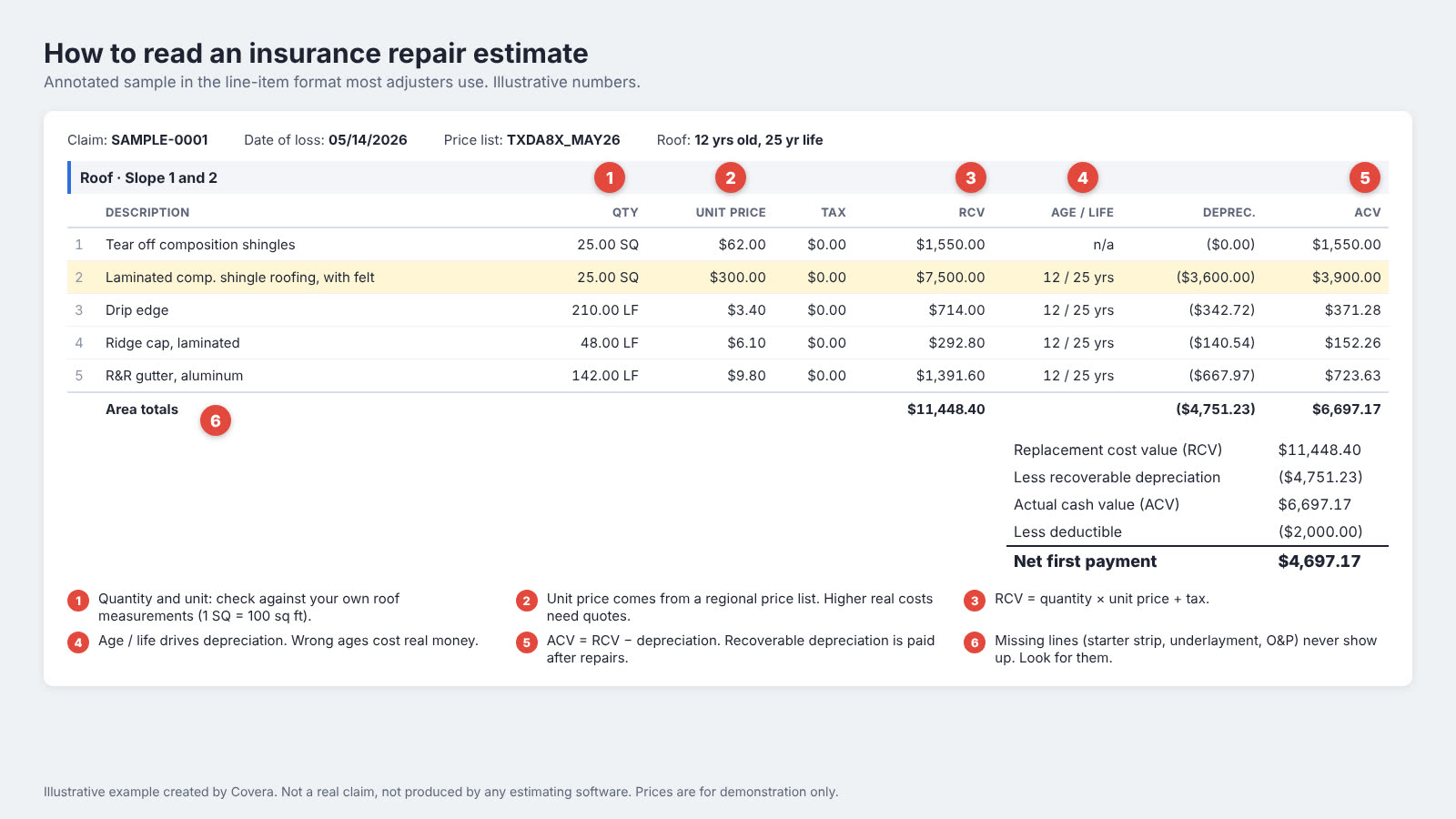
Reading one line item
Here is how a single roofing line breaks down. The numbers are illustrative:
| Column | Example | What it means |
|---|---|---|
| Description | Remove and replace laminated shingles | The work being paid for |
| Quantity | 25.00 SQ | 25 roofing squares (one square = 100 sq ft) |
| Unit price | $300.00 | Price per square from the regional price list |
| Tax | Varies | Sales tax on materials |
| RCV | $7,500.00 | Replacement cost value: quantity times unit price, plus tax |
| Age / life | 12 / 25 yrs | How old the roof is and its assumed useful life |
| Depreciation | ($3,600.00) | Value taken off for age and wear, 48% in this case |
| ACV | $3,900.00 | What you’re paid first; the rest may be recoverable later |
Check every column. Errors in quantity, age or life expectancy are common and can be worth thousands of dollars. If your policy pays replacement cost, the withheld depreciation is usually paid after the work is done. See our guide to recoverable depreciation.
What adjusters often miss in Xactimate estimates
United Policyholders notes that underestimating material costs and lowballing from improper use of Xactimate has factored into many claim disputes and lawsuits, particularly after Gulf Coast hurricanes (United Policyholders). From what we see in claims, these are the items most worth checking:
- Measurements. Compare room sizes and roof squares with your own measurements or your roofer’s report. Check that waste on roofing is included.
- Whole areas missing. A closet, a second bathroom wall, the attic, the garage ceiling.
- Roofing components. Underlayment, starter strip, drip edge, ridge cap, flashing, vents, ice and water shield where code requires it.
- Detach and reset. Gutters, light fixtures, satellite dishes, solar panels and appliances that have to come off and go back on.
- Steep or high roof charges. Extra labor for steep pitches or second stories.
- Prep and cleanup. Content manipulation (moving furniture), floor protection, dumpsters, haul-off and final cleaning.
- Drying and mitigation. Fans, dehumidifiers and monitoring for water losses.
- Painting a full room. Painting one patched wall rarely matches. See our guide to the matching coverage endorsement.
- Permits and code upgrades. Work the building department requires belongs under ordinance or law coverage.
- General contractor overhead and profit. Often left off early estimates. More on this below.
Overhead and profit: the “10 and 10” question
When a general contractor coordinates the repairs, it adds overhead and profit (O&P), commonly 10% overhead and 10% profit, often called “10 and 10.” This is one of the most disputed items in Xactimate estimates.
A few facts help:
- Xactimate unit prices don’t include general O&P. Verisk’s own paper on overhead and profit says general overhead and profit are not included in its published unit prices (Property Insurance Coverage Law Blog). They are added as percentages in the estimate’s settings (Verisk). If your estimate has no O&P line, it simply wasn’t added.
- 10 and 10 isn’t a rule. Verisk leaves the final amounts to the estimator based on the job and the contractor, and Xactimate doesn’t say 10 and 10 is always correct (Property Insurance Coverage Law Blog).
- The “three trades” rule isn’t law in most places. Insurers often pay O&P only when three or more trades are involved, but United Policyholders notes this rule does not seem to have binding authority in most states (United Policyholders). The Florida Supreme Court, for example, ruled that replacement cost includes general contractor O&P if a general contractor could reasonably be expected to be needed for the work (JLC).
If your repair needs a general contractor to coordinate several trades, ask in writing for O&P to be added and explain why.
Why your contractor’s number is different
Many contractors price jobs from subcontractor bids, not from a regional price list. United Policyholders points out that it is hard to compare an Xactimate estimate “apples to apples” with a traditional contractor estimate based on sub-bids, and that if your estimate can’t be compared in an Xactimate format, it is harder to convince the insurer to pay (United Policyholders).
Two ways around that:
- Ask your contractor for an Xactimate estimate. Many insurance restoration contractors write estimates in Xactimate, which makes a line by line comparison easy.
- Map their bid to the adjuster’s line items. If your contractor won’t use Xactimate, ask them to note which of their items match, which are missing from the insurer’s estimate, and which are priced differently, with supplier quotes.
How to challenge an Xactimate estimate
- Ask for the full estimate. Request the complete Xactimate estimate with the sketch and photos, not just the summary page.
- Do a side by side comparison. Put your contractor’s scope next to the adjuster’s, room by room.
- Sort the differences into three groups: missing items, wrong quantities, and price differences. Missing items and wrong measurements are the easiest to win.
- Back every change with evidence. Photos, measurements, code citations, manufacturer instructions, and supplier or subcontractor quotes for price disputes.
- Send a written request. List each line item to add or change, the reason, and the evidence. Ask for a revised estimate.
- Request a reinspection if the adjuster missed damage. See how to request a reinspection.
- Submit supplements during repairs. Damage found after work starts goes in a claim supplement.
- Escalate if needed. If the dispute is only about the amount, consider the appraisal clause or a public adjuster, who usually writes in Xactimate too.
Sample request
Re: Claim number [number], estimate dated [date]
I have compared your estimate with my contractor’s scope. Please revise the estimate to address the following:
1. Roof slope 3 is missing. Photos and measurements attached (6.4 squares).
2. Drip edge and starter strip are not included. Manufacturer installation instructions attached.
3. Detach and reset of gutters (142 linear feet) is not included.
4. General contractor overhead and profit is not included. The repair requires roofing, gutter, interior drywall and painting work coordinated by a general contractor.Please send a revised estimate or explain in writing why each item is not owed.
A request like this gives the adjuster specific items to answer. If you get no response, keep an eye on your state’s claim handling deadlines in our guide to how long an insurer has to pay a claim.
Frequently asked questions
Is Xactimate pricing accurate?
It can be, when the scope is complete and the price list matches your local market. Problems usually come from missing items, wrong measurements, or prices that lag a fast-changing market after a disaster. Line items can be adjusted with evidence such as supplier quotes.
Can I get my own Xactimate estimate?
Yes. Many insurance restoration contractors and public adjusters write estimates in Xactimate. Having one makes it much easier to compare line items with the insurer’s version.
Does Xactimate include overhead and profit?
Not in its unit prices. General contractor overhead and profit is added as a percentage in the estimate’s settings. If your estimate has no O&P and your repair needs a general contractor, ask for it to be added.
What does RCV, ACV and depreciation mean on my estimate?
RCV is the replacement cost value of each item. Depreciation is the amount taken off for age and wear. ACV, actual cash value, is RCV minus depreciation, and it is usually what the first check pays.
What should I do if the Xactimate estimate is too low?
Compare it line by line with your contractor’s scope, list the missing items, wrong quantities and underpriced lines, and send a written request with photos, measurements and quotes. Ask for a reinspection if damage was missed, and consider appraisal or a public adjuster for larger disputes.