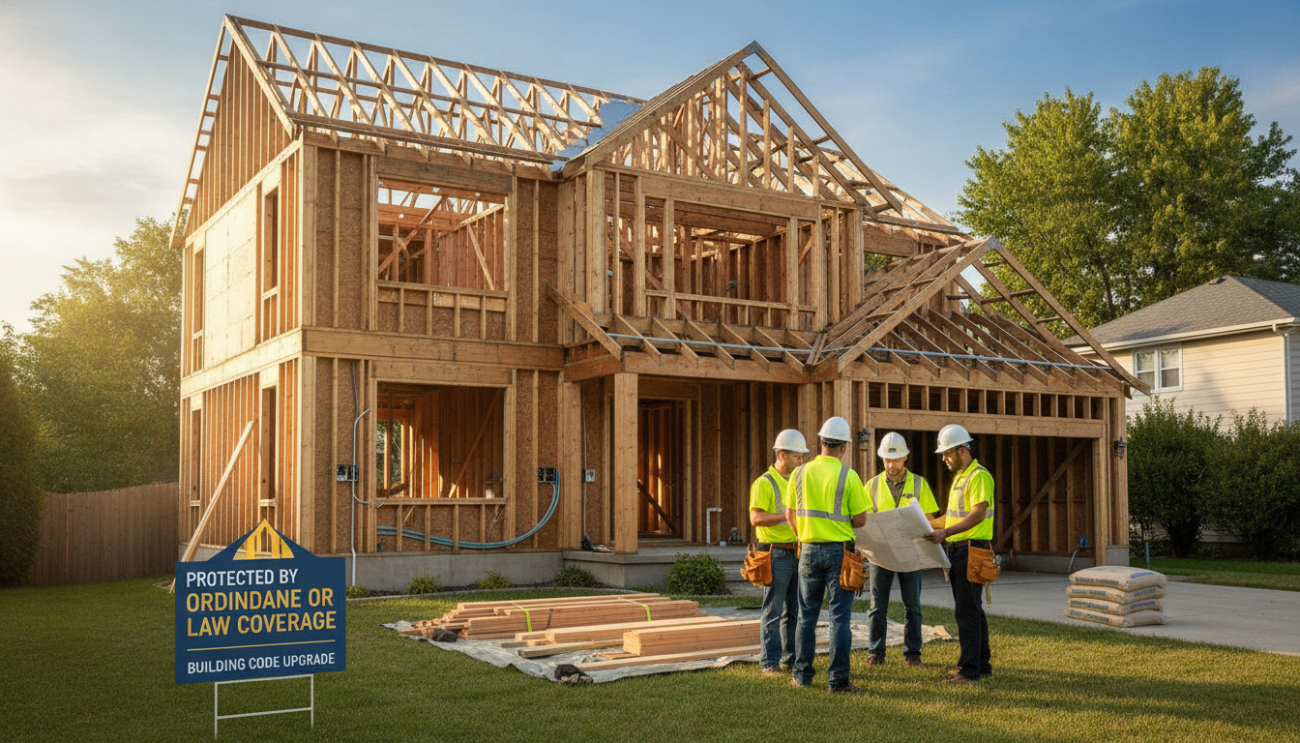
When a major disaster damages your house, you expect your homeowners insurance policy to rebuild it completely. What many property owners discover too late is that local building codes constantly update, requiring costly structural upgrades that standard policies refuse to fund. In this comprehensive guide, you will learn how ordinance or law coverage works, how endorsements protect your finances, what coverage levels cost, and how to verify your protection before disaster strikes.
Featured Snippet: What Is Ordinance or Law Coverage?
Ordinance or law coverage is an essential property insurance endorsement that pays for the increased costs of demolition, reconstruction, and mandatory building code upgrades following a covered loss. Standard dwelling insurance only pays to restore a home to its original condition, leaving property owners personally responsible for code compliance costs without this endorsement.
What Is Ordinance or Law Coverage in Homeowners Insurance?
Most standard homeowners policies (such as an HO-3 or HO-5 contract) are written on a replacement cost basis. Their valuation clause contains an explicit exclusion: insurers only pay to repair or replace damaged property with materials of like kind and quality. They specifically exclude increased costs required to bring an older home into compliance with modern municipal building ordinances or safety codes.
This protection gap is where ordinance or law coverage, commonly known as building code upgrade coverage, becomes indispensable. If a storm tears off your roof, local authorities will not allow your builder to use obsolete trusses or outdated underlayment. Municipal inspectors mandate hurricane strapping, fire-resistant sheathing, or improved venting. If your policy lacks an adequate ordinance or law endorsement, these compulsory updates come out of your own wallet.
Just as homeowners supplement their policies with water backup coverage options and service line coverage for buried utilities, code upgrade protection solves a hazardous structural exclusion in basic policies.
The Three Vital Components of Ordinance or Law Coverage
Comprehensive residential building code endorsements are split into three defined components, labeled Coverages A, B, and C:
- Coverage A (Loss to Undamaged Portion): If local regulations require you to tear down the undamaged half of a home because more than 50% was destroyed, standard dwelling coverage pays only for the burned half. Coverage A pays for the undamaged structure you are mandated to demolish.
- Coverage B (Demolition and Debris Removal Costs): Pays for the physical demolition, carting away, and site clearing of that sound, undamaged section of the house. Standard debris limits rarely cover clearing intact foundations or structural walls.
- Coverage C (Increased Cost of Construction): Pays for extra expenses incurred to bring the rebuilt home into full compliance with current building, electrical, plumbing, and fire safety codes.

A municipal building inspector verifying modern electrical and framing standards during residential reconstruction.
Real-World Example: How Code Upgrades Create Huge Out-of-Pocket Bills
To see how building code updates impact out-of-pocket expenses, consider Marcus, who owns a home built in 1982. A severe kitchen fire destroys 40% of the interior. Marcus holds a policy with $400,000 in Dwelling Coverage, which includes a basic 10% ordinance or law limit ($40,000).
When the restoration contractor applies for local building permits, municipal officials mandate extensive upgrades:
- Full electrical rewiring with modern arc-fault (AFCI) circuit breakers ($22,000).
- Perimeter seismic anchor ties and roof hurricane clips ($14,000).
- Plumbing retrofits with backflow preventers ($11,000).
- Hardwired residential fire sprinklers ($15,000).
Mandatory code upgrades total $62,000. Because Marcus only carried a 10% limit ($40,000), his insurer paid $40,000, leaving Marcus with an unexpected $22,000 out-of-pocket invoice. Had Marcus selected a 25% endorsement ($100,000 limit) for roughly $35 annually, his out-of-pocket balance would have been zero.
Who Needs Ordinance or Law Coverage the Most?
While every property owner gains from code upgrade protection, properties in the following categories face extreme financial risk:
1. Homes Older Than 15 to 20 Years
Building codes update every three years through the International Residential Code. Properties constructed in the 1980s or 1990s fail current standards for insulation R-values, window efficiency, and electrical safety. Older properties naturally require extensive modern compliance work.
2. Coastal and High-Wind Zones
Coastal communities regularly tighten wind mitigation guidelines. Rebuilding an older coastal residence often triggers mandates for impact windows, reinforced roof decking, and elevated foundations. Rental property owners should also check landlord insurance property requirements to ensure adequate building code endorsements.
3. Wildfire and Seismic Hazard Regions
Wildfire regions demand fire-resistant exterior siding, ember-deflecting vents, and defensible space clearing. Seismic zones require sill-plate foundation bolting and plywood shear walls after substantial damage.
4. Historic Districts
Properties in historic preservation zones must satisfy municipal building codes alongside strict architectural guidelines. These commissions often require period-accurate custom millwork or slate roofing, drastically multiplying construction bills.

Consulting an insurance professional to evaluate endorsement options and calculate proper dwelling coverage limits.
How Much Does Ordinance or Law Coverage Cost?
Adding building code upgrade coverage is remarkably affordable. Insurers calculate premiums as a fraction of your baseline dwelling policy. Because major structural code triggers occur primarily during severe claims, annual rates remain modest.
| Coverage Level | Typical Limit ($400,000 Dwelling) | Estimated Annual Premium | Recommended Property Profile |
|---|---|---|---|
| Standard 10% (Included) | $40,000 | $0 (Built into base premium) | New builds (under 5 years old) |
| Increased 25% Endorsement | $100,000 | $25 to $50 per year | Homes aged 10 to 30 years |
| Increased 50% Endorsement | $200,000 | $60 to $110 per year | Homes 30+ years, coastal or seismic zones |
| 100% Full Code Upgrade | $400,000 | $120 to $220 per year | Historic residences, strict municipalities |
Increasing your endorsement to 25% or 50% costs only a few dollars each month. Industry advocates at United Policyholders code compliance guidance caution that code upgrade shortfalls rank among the most frequent causes of out-of-pocket rebuilding debt.
Critical Exclusions: What Ordinance or Law Does Not Cover
While ordinance or law coverage offers valuable protection, it is not a warranty for general maintenance. Insurers define strict contractual boundaries:
- Loss Must Stem From a Covered Peril: If an inspector discovers faulty wiring during an elective remodel, insurance will not reimburse you. The damage must originate from a covered peril, like wind or fire, as detailed in the Insurance Information Institute overview.
- Pollution and Mold Remediation: Hazardous material removal, like asbestos abatement, is excluded unless your policy includes a distinct environmental rider.
- Pre-Existing Code Citations: Violations cited by local building departments before a loss occurred are not covered. Maintaining compliance is always the property owner’s obligation, whether owning a house or choosing adequate property insurance limits.
How to Check Your Policy and Add Coverage
Verifying your coverage takes just minutes by following these four steps:
- Review Your Declarations Page: Search your policy endorsements for terms like “Ordinance or Law” or “Building Code Upgrade.”
- Check Your Percentage Limit: Most policies set a 10% default. If your home was constructed before 2010, this limit will likely leave you underinsured during a major rebuild.
- Request an Endorsement Quote: Ask your broker to price an increase to 25% or 50%. This update usually adds only $3 to $8 per month to your bill.
- Share Completed Renovations: If you recently upgraded your electrical wiring or plumbing, inform your insurer to ensure you qualify for modernized home discounts.
Frequently Asked Questions About Ordinance or Law Coverage
Is ordinance or law coverage automatically included in homeowners policies?
Standard policies often include a 10% allowance of Coverage A for code updates. However, some basic policies exclude it completely unless added via endorsement. Because 10% is rarely sufficient for homes older than 15 years, expanding this coverage is strongly advised.
What is the 50 percent rule in municipal building codes?
The 50 percent rule specifies that if a structure incurs damage exceeding 50 percent of its value or footprint, the entire structure must be brought up to contemporary codes. If required, the undamaged portion must be torn down and rebuilt, which activates Coverages A and B under an ordinance or law endorsement.
Does code upgrade protection apply to partial damage?
Yes. If a localized fire damages a kitchen but municipal code requires upgrading the entire home electrical panel to issue repair permits, ordinance or law coverage funds the panel replacement. It applies to all compulsory code improvements triggered by a covered loss.
How much ordinance or law coverage should I buy?
Homes under 10 years old are generally safe with 10% coverage. For homes aged 10 to 30 years, experts advise at least 25% coverage. Homes over 30 years old, coastal properties, or historic buildings should carry 50% to 100% to prevent substantial out-of-pocket costs.
Final Thoughts: Protect Your Home Against Rebuilding Gaps
Building codes safeguard residents, but complying with newer construction mandates can be financially devastating after a disaster. Relying on basic dwelling coverage leaves you exposed to tens of thousands of dollars in surprise permits and retrofits. Adding an ordinance or law endorsement ensures your home is rebuilt safely, legally, and without draining your savings.
Take time today to examine your policy declarations page, consult your agent, and secure the code upgrade protection your home needs.