
A denial letter feels final. In most cases it is the insurer’s opening position, and you can challenge it. The fastest way to do that is to find the exact reason in the letter, match it with evidence that answers that reason, and send a written appeal, while you keep an eye on the deadline to sue, because in many states an appeal does not stop that clock.
Quick answer: If your home insurance claim was denied, (1) get the denial in writing with the policy wording it relies on, (2) request a full copy of your policy and the adjuster’s estimate or report, (3) answer each stated reason with specific evidence, such as a contractor or engineer report, photos, receipts and a timeline, (4) send a written appeal and ask for a reinspection, and (5) if that fails, file a complaint with your state insurance department and talk to a public adjuster or attorney before your policy’s suit deadline runs out.
Why most denial advice misses the real problem
Most guides give you the same list: appeal, hire a public adjuster, complain to the state, call a lawyer. That list is fine, but it leaves out two things that decide whether an appeal works.
- The reason matters more than the effort. An appeal that says “please reconsider” with a pile of photos rarely moves anything. An appeal that answers the one sentence the adjuster wrote, with the right type of proof, often does.
- Time keeps running. Home policies usually have a suit limitation clause, often one or two years. In California, the courts have held that the clock pauses while the insurer is first deciding your claim, and starts again once it denies in writing. A later request to reconsider does not pause it again. In Singh v. Allstate (1998), the court refused a second pause for a reconsideration after denial, and a 2025 Ninth Circuit memorandum applied the same rule to a homeowner whose claim was reinvestigated after a formal denial.
So the plan is simple: fight the reason, and keep the deadline on your calendar from day one.
Step 1: Get the denial in writing, with the policy wording
A phone call saying “that’s not covered” is not enough to work with. Ask for a written denial that names the exclusion or condition and explains how it applies to your loss. Many states require it.
- California: Under 10 CCR 2695.7, a denial of a first party claim must be in writing, list every basis for the denial with its factual and legal basis, and refer to and explain the policy provision it relies on.
- Texas: Texas Insurance Code 542.056 requires written notice of acceptance or rejection no later than 15 business days after the insurer receives all the items it asked for, and a rejection must state its reasons.
- Florida: Section 627.70131 requires the insurer to pay or deny within 60 days of notice of the claim and to give a reasonable written explanation of the policy basis for a denial or partial denial.
If the letter is vague (“damage not covered under the policy”), write back and ask which provision applies and what facts the adjuster relied on. That request is free, it creates a paper trail, and in states with written denial rules it puts pressure on the insurer to be specific. For deadlines in other states, see our guide on how long an insurance company has to pay a claim.
Step 2: Collect the three documents you need
Before you write anything, get these in hand:
- The full policy, including the declarations page and every endorsement. The exclusion cited in the letter may be changed by an endorsement you forgot you bought, such as water backup or matching coverage.
- The adjuster’s estimate, photos and any expert report. Ask for the engineer or roofer report the insurer used. In Florida, the Homeowner Claims Bill of Rights gives you the right to a copy of any detailed estimate within 7 days after it is generated.
- Your own record: date of loss, date you reported it, claim number, names of everyone you spoke with, and copies of every email and letter.
Then read the cited exclusion next to the policy’s definitions. Words like “flood”, “surface water”, “collapse” and “sudden” are often defined, and the definition can be narrower than the adjuster’s use of the word.
Step 3: Match the denial reason with the right evidence
This is the part most homeowners skip. The table below lists the reasons that show up most often in home claim denials and what kind of proof actually answers each one.
| Reason in the letter | What the insurer is saying | Evidence that answers it |
|---|---|---|
| Wear and tear, deterioration, age | The damage came from slow aging, not a covered event | Report from a licensed roofer or engineer tying damage to a dated storm; weather data for that date (hail size, wind speed); photos from before the loss; maintenance receipts |
| Repeated seepage or long term leak | Water leaked for weeks or months | Plumber’s report on when and how the pipe failed; water bills showing a sudden spike; moisture readings; the date you first noticed staining |
| Flood or surface water exclusion | Water came from outside at ground level | Proof the water entered another way (roof opening, burst pipe, sewer backup with backup coverage); photos of the entry point; contractor statement |
| Late notice | You reported too late and the insurer could not investigate | Timeline showing when the damage became visible; proof you reported promptly once you knew; evidence the insurer could still inspect (photos, kept materials) |
| Failure to mitigate | You let the damage get worse | Receipts for tarps, water extraction, board up; photos of temporary repairs; texts showing you tried to reach contractors |
| Cosmetic damage only | Dents affect looks, not function | Roofer report on punctures, cracked mats, lost granules or water entry; the exact cosmetic exclusion wording and its definition |
| Misrepresentation or lack of documentation | Something you said or sent does not add up | Corrected, consistent statements; receipts, bank records, photos of items; a written explanation of any honest mistake |
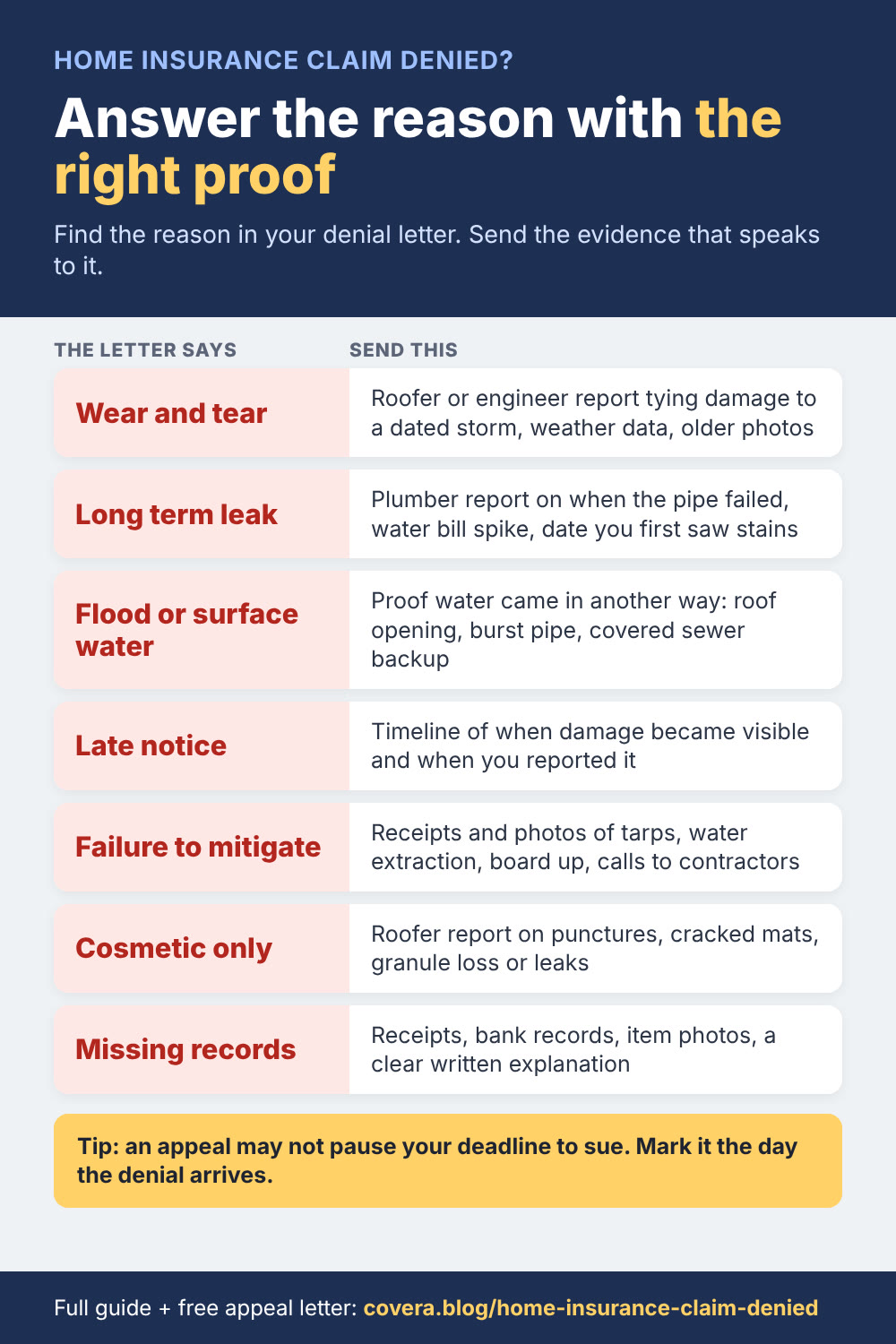
Two things to check in your own letter. First, “wear and tear” is often stated as a conclusion with no measurements behind it. Ask what the adjuster saw that pointed to age instead of storm damage. Second, a denial can cover only part of a claim. If the insurer accepted the interior water damage but denied the roof, treat them as two separate fights, and make sure you are paid the undisputed part now.
If you want an expert, pick one whose report will speak to the exact reason given. A general contractor’s repair estimate does not answer a “pre-existing damage” denial. A roof inspection report that dates the fractures does.
Step 4: Write the appeal letter
Free template: home insurance claim denial appeal letter (PDF)
A fill in the blanks letter that follows the structure below, plus a one page checklist and a claim log with a line for your deadline to sue.
Your appeal should be short, specific and in writing. Email works if you also keep a copy. Use this structure:
- Header: your name, address, policy number, claim number, date of loss.
- What you are asking for: “I am asking you to reverse the denial dated [date] and pay the claim, or to reinspect the property with my contractor present.”
- The reason, quoted: copy the sentence from the denial letter.
- Your answer: one short paragraph per reason, each pointing to an attached document. “The enclosed report from [roofer], dated [date], found [finding] consistent with hail on [date].”
- The policy wording: quote the coverage grant and, if it helps you, the definition that narrows the exclusion.
- A deadline for a response: ask for a written answer within a set number of days, such as 15 or 30, and a written explanation if the denial stands.
Keep emotion out of it. Adjusters and reviewers respond to documents. Asking for a second inspection, ideally with your contractor on site, is often the most useful single request. Our guide to a home insurance claim reinspection explains how to set it up.
Step 5: If the appeal fails, choose the right escalation
Different problems need different tools. Picking the wrong one wastes months.
| Option | Best for | Keep in mind |
|---|---|---|
| State insurance department complaint | Delays, no written reasons, ignored messages, rule violations | Free. The NAIC explains that the department forwards your complaint to the insurer for a response. It cannot act as your lawyer or force a payout on a genuine coverage dispute. |
| Public adjuster | Large claims where documentation and valuation are the problem | Paid as a percentage. Read our guide on when a public adjuster pays off. |
| Appraisal | The insurer agrees the loss is covered but disputes the amount | Usually cannot decide whether something is covered at all. See the appraisal clause guide. |
| Mediation | States with a state run program, mid sized disputes | Availability depends on your state. See claim mediation. |
| Insurance attorney | Large denials, coverage disputes, signs of bad faith, close deadlines | Many work on contingency. Some states require pre-suit notice. Texas, for example, generally requires written notice at least 61 days before suit, as United Policyholders explains. |
A complaint and an appeal can run at the same time. If the insurer ignores your letters or never explains its reasons, a complaint is often the step that gets a real reply.
Watch the deadline to sue from day one
Find the clause in your policy usually titled “Suit Against Us”. It sets how long you have to file a lawsuit, and it is often much shorter than the general statute of limitations for contracts. California’s standard fire policy language, required by Insurance Code section 2071, gives 12 months from the inception of the loss, and the California Supreme Court held in Prudential-LMI v. Superior Court (1990) that the period is paused from timely notice until the insurer’s formal written denial.
Here is how that plays out. Say a pipe bursts on March 1, you report it on March 3, and the insurer denies in writing on May 1. Roughly two days of your 12 months have passed. The clock restarts on May 1, so you have about 11 months and 28 days left. If you then spend eight months on appeals and reinspections, those months count. Rules differ by state, and some policies run the clock from the date of loss with no pause, so ask an attorney to confirm your date early.
Deadline to sue your home insurer in six states
The table shows the floor each state sets for the “Suit Against Us” clause, or how courts treat it. Your policy can give you more time, so the policy wording is still the first thing to check.
| State | Deadline to sue | What to watch |
|---|---|---|
| California | At least 12 months from the inception of the loss; 24 months if the loss is related to a declared state of emergency (Ins. Code 2071) | Paused from timely notice until a written denial. A request to reconsider after denial does not pause it again. |
| Texas | A contract term shorter than two years is void under Civ. Prac. & Rem. Code 16.070. Policies that follow Ins. Code 2301.010 cannot end before the earlier of two years from acceptance or rejection or three years from the loss. | Written notice at least 61 days before suit is generally required. |
| Florida | Five years from the date of loss for breach of a property insurance contract (s. 95.11(2)(e)) | The claim itself must be reported within 1 year of the loss, or 18 months for a supplemental claim (s. 627.70132). Florida also has a pre-suit notice process. |
| Louisiana | A policy cannot cut the time to sue on a first party claim below 24 months after the inception of the loss (R.S. 22:868) | The clock starts when the damage happened, not when you filed the claim. |
| New York | Policies commonly require suit within two years after the loss, following Insurance Law 3404(e) | Courts read the exact wording. Some policies run from the date of loss, others from when a claim could be brought. |
| Georgia | Courts enforce one year clauses in homeowners policies (White v. State Farm) | One of the shortest windows. Mark the date as soon as the loss happens. |
Laws change and courts read policy wording closely, so treat this table as a starting point and confirm your own date with a licensed attorney in your state.
Practical rule: write the suit deadline at the top of your claim file the day the denial arrives, and talk to an attorney at least two or three months before it, even if the appeal still looks promising.
Example: a wear and tear roof denial, start to finish
This is an illustrative scenario that shows how the steps fit together. The names and numbers are made up.
The loss. A hailstorm hits Maria’s neighborhood on April 12. Two weeks later she sees a ceiling stain in the upstairs bedroom and reports the claim on April 28. The adjuster inspects on May 9.
The denial. On June 2 she gets a letter: “Damage to the roof is consistent with age related deterioration and is excluded under Section I Exclusions, wear and tear.” No measurements, no photos of hail marks, no mention of the storm.
What she does in the first week.
- She writes the deadline to sue at the top of her claim file, using the “Suit Against Us” clause in her policy.
- She emails the adjuster asking for the inspection photos, the estimate and any roof report the insurer relied on.
- She hires a licensed roofer for an inspection. The report notes circular bruises and fractured mats on the south and west slopes, matching the storm direction, and lists the roof as 9 years old with no prior repairs.
- She downloads a hail report for her ZIP code showing hail on April 12, and finds a phone photo of the roof from last summer with no visible damage.
The appeal. Her letter quotes the denial sentence, attaches the roofer’s report (A), the hail report (B), the older photo (C) and a short timeline (D), and asks the insurer to reverse the denial or reinspect with her roofer on site, with a written answer within 30 days.
What happens next. One of three things usually follows. The insurer reinspects and pays some or all of the roof. It agrees the loss is covered but offers less than her roofer’s estimate, which turns the dispute into one about the amount, where appraisal may fit. Or it stands by the denial, and she files a state complaint and talks to an attorney well before her deadline. Whichever happens, her file now shows a dated storm, an expert finding and a clear request, which is what a reviewer, a regulator or a lawyer will look for first.
Mistakes that make a denial harder to reverse
- Throwing away damaged materials before the insurer or your expert has seen them. Photograph, label and keep samples.
- Making full permanent repairs without documenting the damage first. Reasonable temporary repairs are fine and often required.
- Giving a new recorded statement that conflicts with earlier ones. If one is requested on appeal, prepare first.
- Accepting a “reconsideration” by phone without anything in writing. Ask for every decision in writing.
- Waiting for the insurer to act. Set your own follow up dates and send short written reminders.
If the insurer is ignoring evidence, changing its reasons, or stalling, read our guide to homeowners insurance bad faith so you know what to document.
Home insurance claim denied: FAQs
Can you appeal a home insurance claim denial?
Yes. Most insurers will review a written appeal with new evidence, and many will send a different adjuster or reinspect. There is usually no formal appeal form, so a clear letter with attachments works.
How long do I have to appeal a denied home insurance claim?
Few policies set an internal appeal deadline, but the policy’s suit limitation clause still applies, often one or two years. In some states, including California, time spent on an appeal after a written denial counts against that period, so act quickly. See the state deadline table for six examples.
Does a denied claim go on my CLUE report?
It can. Claims and even some inquiries may appear on your CLUE report whether or not they were paid. You can request a free copy and dispute errors.
Should I hire a lawyer or a public adjuster?
A public adjuster fits when the claim is covered but undervalued or poorly documented. A lawyer fits when the insurer says the loss is not covered at all, when the amount is large, or when the suit deadline is getting close.
Will complaining to the state insurance department get my claim paid?
Sometimes. The department makes the insurer respond in writing and checks whether it followed state rules. It does not usually decide disputed facts, so pair the complaint with your evidence based appeal.
This article is general information, not legal advice. Policy wording and state rules vary, so check your own policy and consider talking to a licensed professional in your state about your deadlines.