Your insurer’s first repair estimate may miss damage that only becomes clear once work begins. That does not mean you must pay every newly discovered cost yourself. An insurance claim supplement lets you ask the carrier to review specific, documented changes to a covered repair. Here is how to build a clear request, track the decision, and avoid confusing extra repair money with a second claim.
What is an insurance claim supplement?
An insurance claim supplement is a request to revise an existing claim estimate when covered damage, repair quantities, code requirements, or reasonable costs were missed or changed. Send the adjuster a line-item comparison and supporting evidence, then ask for a written coverage decision. Approval is not automatic, and your policy terms still govern payment.
Most homeowners encounter supplements after a contractor opens a roof, wall, or floor and finds damage that was not visible during the first inspection. The supplement generally stays under the original claim number. It is not permission to upgrade to nicer materials at the insurer’s expense, and it does not erase your deductible.
When does a supplemental insurance claim make sense?
Look for a real difference between the insurer’s scope and the work needed to restore the covered property. Examples include missing flashing around a chimney, damaged decking exposed after shingles are removed, an underestimated number of siding panels, or labor needed to remove and reinstall equipment.
A higher contractor bid alone does not prove the insurer owes the difference. Compare the same scope, materials, quantities, local labor assumptions, and tax. If the contractor proposes a better roof than the one you had, separate the elective upgrade from necessary covered repairs.
- Newly revealed damage: photograph deteriorated material as soon as it is exposed, before removal hides the evidence.
- Missing work: identify a repair operation omitted from the adjuster’s estimate and explain why it is necessary.
- Quantity or price differences: provide measurements and a local bid rather than a round-number request.
- Code-related work: cite the applicable local provision and confirm whether your policy includes enough ordinance or law coverage for building-code upgrades.
If the dispute is whether the storm caused the damage at all, a supplement may require more than a revised price sheet. Ask what evidence the insurer needs to reconsider causation. For a better sense of the initial inspection, read what a claim adjuster looks for at a property.
How to request an insurance claim supplement
1. Compare the two estimates line by line
Request the insurer’s complete itemized estimate, not just the check amount. Have your contractor mark each disputed line with the original quantity and price, the proposed revision, and the reason. Use the same room, roof plane, or elevation labels where possible so the adjuster can follow the difference.
For a roof insurance supplement, a sketch with dimensions helps connect claimed squares of roofing, linear feet of flashing, and pieces of decking to the physical job. If the insurer uses a roof surface payment schedule, check that endorsement before assuming every approved repair dollar is paid at replacement cost.
2. Document the hidden storm damage
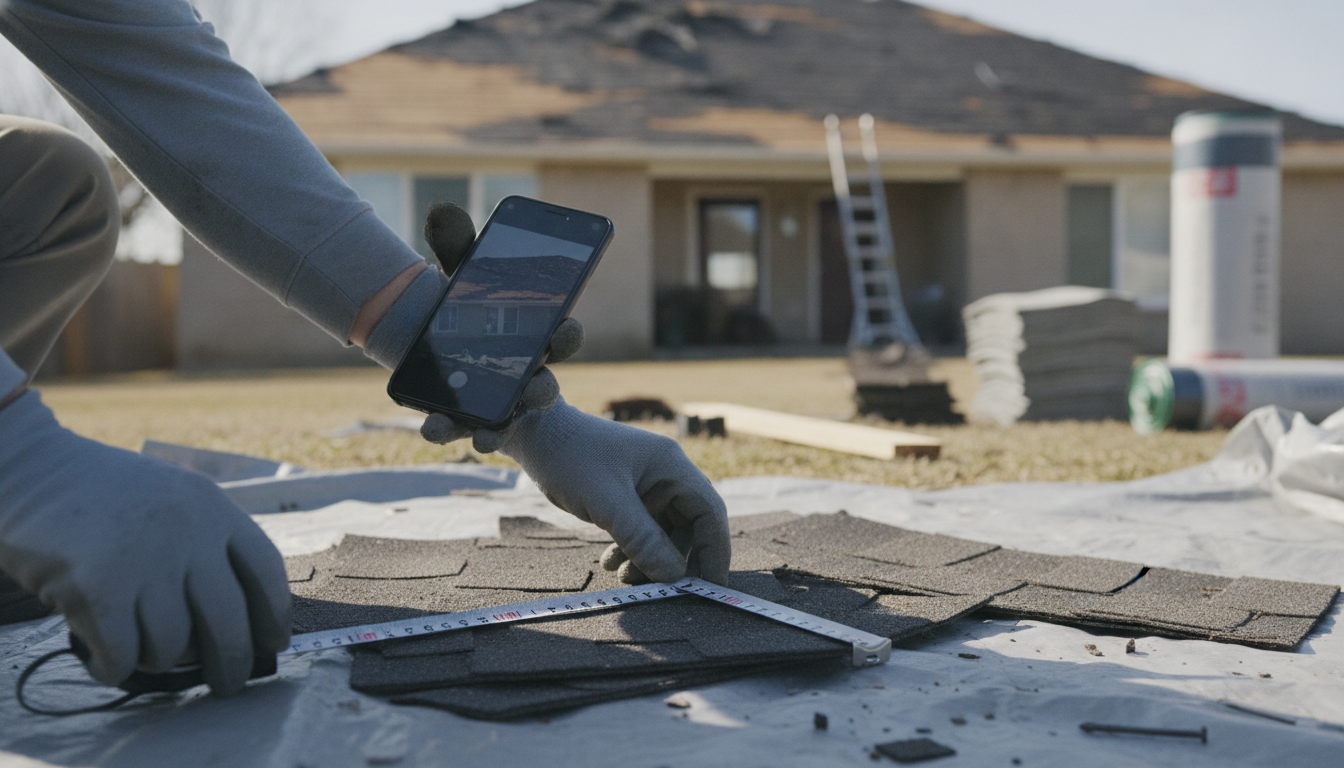
Take wide photos showing location, close-ups showing the defect, and a measurement or label that ties each picture to the estimate. Save dated photos from before and during work, material invoices, inspection notes, and any relevant permit or code citation. If emergency work cannot wait, ask the contractor to preserve evidence and send the carrier notice promptly.
The California Department of Insurance residential property claims guide advises consumers that additional damage discovered later can generally be brought back to the insurer for review. Procedures and deadlines vary by state and policy, so do not treat that guidance as a universal extension of your own deadline.
3. Send one organized request and ask for confirmation
Use the claim portal or the email address your adjuster gives you. Put the claim number and property address in the subject line. Attach the itemized contractor repair estimate, labeled photos, measurements, code documentation if relevant, and a short cover note listing the disputed items. Keep copies of everything you submit.
A concise note can say: “Please review the attached supplemental estimate for claim [number]. We found damaged decking on the north roof slope during tear-off. Photos 1 to 4, the roof sketch, and estimate lines 12 to 14 document the requested change. Please confirm receipt and advise whether a reinspection is needed.”
Ask the adjuster for written confirmation of what was received, the next step, and any missing evidence. Do not sign a contractor agreement that promises a particular insurance payment or lets the contractor act as a public adjuster where licensing rules forbid it.
4. Review the revised estimate and payment
Approval can be partial. Match every changed line to the new estimate and explanation, then compare gross covered cost, deductible, prior payments, and any depreciation withheld. Ask the carrier to explain a denied line in writing. A supplemental payment may go to you and a mortgage lender, depending on the claim and loan documents.
Travelers explains that recoverable depreciation has its own proof and timing rules. A supplement changes the estimated covered repair scope; recoverable depreciation is a different payment step tied to repair or replacement under applicable policy terms. One does not automatically trigger the other.
A worked roof insurance supplement example
Suppose a windstorm damages a roof. The insurer initially allows $11,000 for covered roof work. During tear-off, the roofer photographs damaged decking and missing flashing. A documented estimate adds $1,800 for necessary covered work. If the insurer approves all of it, the revised covered estimate is $12,800, before applying policy-specific depreciation, prior payments, and the deductible.
With a $2,000 deductible, the simple example’s total net covered amount would be $10,800, not $12,800, if there were no other adjustments. The $1,800 supplement does not create a new $2,000 deductible when it remains part of the same covered claim. Your actual figures may differ if depreciation is withheld, coverage limits apply, or the added work is excluded. See how a wind and hail deductible affects claim payments before budgeting the job.

What if the insurance claim supplement is denied?
First, determine why. A price disagreement, an omitted photo, an exclusion, and a disputed storm cause call for different responses. Ask for the specific policy language or factual basis used, then respond to each disputed line with evidence. If new damage was uncovered after the claim appeared closed, ask whether it can be reopened under the policy and local law.
- For missing scope, submit clearer location photos and a contractor’s detailed explanation.
- For code work, provide the local code provision, permit requirement, and applicable policy endorsement.
- For pricing, compare like-for-like materials and obtain a second local bid if needed.
- For a stalled or unresolved dispute, ask about the insurer’s internal review, your state insurance department, and any appraisal clause. Appraisal usually addresses the amount of loss, not every coverage dispute.
Watch the calendar while you seek review. The storm damage repair timeline can affect notices, repair proof, and available payment. Read your policy and claim correspondence for deadlines rather than relying on a contractor’s general rule.
Frequently asked questions
Does an insurance claim supplement create a new claim?
Usually no. It is typically a request to revise the existing covered loss under the same claim number. Confirm with your adjuster if the newly discovered damage may stem from a separate event.
Can I request a supplement after repairs are finished?
Possibly, but photos and inspection opportunities are easier to preserve before work is complete. Contact the insurer promptly, save invoices and dated evidence, and check your policy and state-specific time limits.
Will the insurer pay my contractor’s entire estimate?
Not automatically. The insurer assesses coverage, reasonable scope and pricing, limits, exclusions, and your deductible. An itemized bid with proof gives the adjuster something specific to evaluate.
Is a supplement the same as recoverable depreciation?
No. A supplement requests a change to the covered repair estimate. Recoverable depreciation is an amount withheld from an initial replacement-cost payment that may be released when qualifying repair or replacement is proved.
Make your next step count
If the first estimate does not match the damage, request the full line-item breakdown and have a qualified contractor document every difference before sending a supplement. Keep copies, ask for a written response, and compare the revised numbers with your policy. Have you faced a missing repair line on a claim? Share the documentation that helped in the comments so other homeowners know what to prepare.