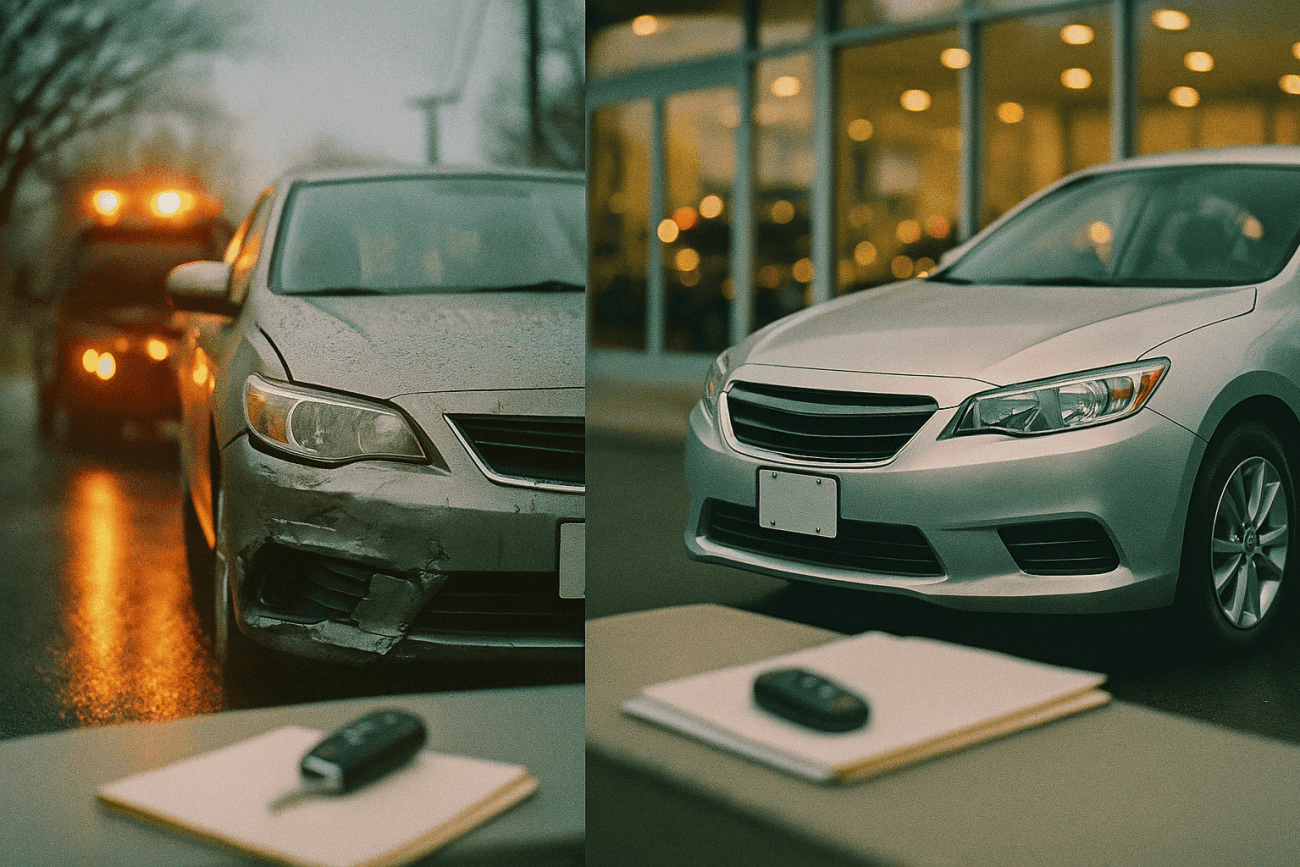
Buying a new vehicle is one of those moments where the paperwork feels endless and every add-on is pitched as “peace of mind.” Two of the most commonly confused options are GAP insurance and new car replacement coverage. They sound similar because both come into play after a total loss, yet they solve different money problems.
If you only remember one thing, remember this: GAP helps you get out from under a loan or lease balance after a total loss, while new car replacement helps you get back into a brand-new car after a total loss.
Why total-loss payouts often feel unfair
Most auto policies settle total losses using actual cash value (ACV). ACV is basically what your car was worth right before the crash or theft, based on age, mileage, condition, trim, and local market pricing.
That matters because cars depreciate fast, especially in the first year. So even if you bought your car recently, the insurance payout may be thousands less than what you paid.
If you financed with a low down payment, rolled taxes and fees into the loan, chose a long term, or paid above MSRP, you can end up owing more than the car is worth. That gap is where these coverages enter the conversation.
What GAP insurance actually does
GAP insurance (often called loan/lease payoff coverage) is designed to handle one specific problem: negative equity after a total loss.
Here’s the basic flow in a covered total loss or theft:
- Your auto insurer pays ACV (minus your deductible) to you and/or your lender.
- If that payment is not enough to satisfy your loan or lease payoff, GAP pays the difference, up to the limits of the contract.
It’s protection for the balance sheet, not a replacement vehicle benefit. After the claim, you typically end up with no car and no remaining loan/lease balance.
GAP is usually offered through auto insurers, lenders, credit unions, and dealerships. It’s often easiest and cheapest through your auto insurer, but availability depends on the carrier and your vehicle’s age.
Common limitations are where people get surprised. GAP is usually narrow by design.
After you read the offer, watch for these items that are often excluded or limited:
- Late payments and past-due amounts: unpaid interest, penalties, or delinquent installments typically stay your responsibility
- Rolled-in extras: service contracts, extended warranties, credit insurance, and similar items may not be covered
- Lease-end charges: excess mileage, wear and tear, and disposition fees usually are not part of the payoff GAP handles
What new car replacement coverage really pays for
New car replacement is an endorsement on an auto policy that changes the payout after a total loss. Instead of receiving ACV, you receive enough to replace your totaled car with a brand-new vehicle of the same make and model, minus your deductible.
This is depreciation protection. You are paying for the right to ignore the early value drop that ACV captures.
The catch is eligibility. New car replacement is typically limited to vehicles that are still “new” under the insurer’s definition, usually based on model year, time since purchase, and mileage. Many carriers cap it at about one to two years and a mileage threshold.
New car replacement also normally requires that you carry “full coverage” (collision and comprehensive) and that the vehicle is not too old or previously owned. Some policies limit the payout, like a percentage of MSRP or a maximum replacement amount.
Side-by-side: what each one is built to fix
Both coverages help after a total loss, but they aim at different outcomes. GAP is about not owing money on a car you cannot drive. New car replacement is about not being forced to “downgrade” into a used-car payout when you just bought new.
Here’s a quick comparison that lines up how they work in real life.
| Topic | GAP insurance (loan/lease payoff) | New car replacement |
|---|---|---|
| What triggers it | Total loss or theft (with comp/collision in force) | Total loss or theft (with comp/collision in force) |
| Main benefit | Pays the difference between ACV payout and loan/lease payoff | Pays to replace with a brand-new same make/model (minus deductible) |
| What it protects | Your debt after depreciation | Your vehicle value after depreciation |
| What you end up with | No car, and ideally no remaining loan/lease balance | A path to a new replacement car, still responsible for any loan payoff unless the payout covers it |
| Common limits | Excludes overdue amounts and add-ons rolled into financing | Strict age/mileage limits, payout caps, may end after a short window |
| Best fit | Long loans, low down payments, leases, negative equity risk | Brand-new purchases where you want a new replacement if the worst happens |
A simple numbers example (and what it teaches)
Imagine you financed a $40,000 new car and a few months later it’s totaled.
- The insurer determines ACV is $35,000.
- You still owe $37,000 on the loan.
- Your collision deductible is $500.
With no add-ons: the insurer pays $34,500 after deductible (depending on how the check is issued), and you could still owe the lender about $2,500.
With GAP: after the ACV settlement, GAP may cover the remaining payoff gap (often the shortfall tied to ACV vs payoff, subject to the contract). You walk away not owing on the loan, but you still need another vehicle.
With new car replacement: the insurer pays based on the cost of a brand-new equivalent vehicle, minus your deductible. That larger payout can make it much easier to pay off the existing loan and move into a replacement car without taking the depreciation hit.
The lesson is that the same crash can create two different problems: a debt problem (owing the lender) and a replacement problem (buying another car). The two coverages address those problems differently.
When GAP tends to be the better buy
GAP is usually most valuable when your loan balance is likely to be higher than your car’s ACV early in the term. That risk rises with small down payments, long terms, high interest rates, and any situation where the purchase price is “front-loaded” with fees.
A quick way to frame it is to ask: “If my car vanished today, would my insurance check pay off my loan?”
If you are not confident the answer is yes, GAP deserves a serious look.
Many leases already include a version of GAP in the lease contract, or the lessor requires it. Still, you should verify what is included and whether it is insurance or a contractual waiver.
When new car replacement tends to be the better fit
New car replacement is usually about preference and lifestyle as much as finance. Some people are fine taking an ACV payout and shopping used. Others want to get back into the same class of car they just bought without paying for depreciation out of pocket.
This option is most attractive when:
- You bought new and want a new replacement, not a used equivalent
- Your vehicle depreciates quickly
- You rely on the car for commuting or family logistics and want less disruption after a total loss
It is less useful if your car is already outside the eligibility window, you are comfortable buying used, or you mainly care about eliminating loan risk rather than replacing with new.
Can you carry both?
Sometimes yes, sometimes no.
Some insurers restrict pairing these endorsements. They may view the combination as overlapping or may cap benefits to prevent an overpayment scenario. Other insurers allow both, but you have to read how they coordinate benefits, especially how the loan payoff is handled when a replacement value payout is involved.
If you want both protections, ask the carrier a very direct question: “If my car is totaled next month, will I end up with (1) the loan paid off and (2) enough to replace with a new same model?” Then request the answer in writing or point to the policy language.
Leases are their own category. New car replacement is less common and sometimes awkward on a lease, because you do not own the vehicle and the lessor’s payoff rules control the settlement flow.
Buying it from a dealer vs buying it from your insurer
This is where cost and cancellation rules matter.
Dealer-sold GAP is often a one-time fee rolled into the loan. That can be convenient, but it can also mean you pay interest on it for years. Insurer-sold GAP is commonly a small annual premium added to your policy, and you can typically remove it once your loan balance drops below the car’s value.
New car replacement is usually only available through auto insurers as an endorsement. You pay for it with your policy premium, and it typically drops off once the car ages out of eligibility.
Before you sign, make sure you know whether you can cancel midterm and whether any refund is pro-rated.
A practical “choose this if…” guide
Most decisions become clearer when you tie them to a single goal. If you want a fast way to decide what to ask for, start here:
- You want to avoid owing money after a total loss: consider GAP first
- You want to avoid taking a depreciation hit on a new car: consider new car replacement
- You have a lease: confirm whether GAP is already built into the lease contract and what it covers
- You put little or nothing down: GAP often matters more than people expect in the first year
- You rotate cars every few years: new car replacement can match that habit, since it is limited to newer vehicles
What to check in the fine print before you pay for either
The value of both options comes down to the policy wording, not the sales pitch. A few minutes of review can prevent the classic surprise where coverage exists, but not for the situation you assumed.
Look for these details:
- Eligibility window (days after purchase you must add it)
- Vehicle age and mileage limits
- Payout caps (percentage of MSRP, maximum dollar amounts)
- Deductible handling (waived, covered, or fully applied)
- Exclusions for past-due payments, rolled-in products, and lease fees
- Whether the coverage is allowed if you refinance, extend the loan, or roll negative equity into a new loan
It also helps to confirm what you actually owe versus what your car is worth today. Your lender can provide a payoff quote, and used-car pricing tools can help you estimate market value. That comparison tells you whether the “gap” is real and how large it is.
What the claims process looks like in real life
Both coverages are triggered only after a total loss is confirmed, and that can take time. Insurers usually need a valuation report, title and lienholder details, and sometimes documentation of vehicle condition and options.
With GAP, you generally complete the standard auto claim first. Once the ACV settlement is issued and the lender confirms the remaining payoff, the GAP provider reviews documents and pays the covered difference, often directly to the lender.
With new car replacement, the insurer handles it as part of the total-loss settlement. You still pay your collision or comprehensive deductible. The insurer then pays based on the endorsement terms, which may require proof that you are replacing with the same model or may simply pay a calculated replacement amount.
If you want fewer delays, keep your paperwork ready: purchase contract, finance agreement, payoff contact info, maintenance records, and photos that show condition before the loss if you have them.
A final way to sanity-check your choice
If you are stuck between the two, ask yourself which bad outcome would bother you more:
Owing thousands on a car you cannot drive, or being forced to start over with a used-car budget after you just bought new.
Those are different fears, and they point to different coverage. The right answer is often a match between your loan structure and your tolerance for depreciation, with a quick verification that your insurer will actually offer the endorsement on your vehicle and in your state.