
When a sudden storm rips through your condominium community or a visitor slips on an icy shared walkway, your homeowners association (HOA) turns to its master policy. But what happens when the damage exceeds policy limits, or the association faces a massive $100,000 deductible? In this guide, you will learn how loss assessment coverage works, what it costs, how it shields your personal savings, and how to choose the right policy limit.
Quick Answer: What Is Loss Assessment Coverage?
Loss assessment coverage is an optional endorsement on a condo (HO-6) or homeowners (HO-3) policy that pays your share of special assessments levied by your HOA or condo board. When covered property damage or liability claims exceed master policy limits or reserves, this rider prevents you from paying thousands of dollars out of pocket.
What Is Loss Assessment Coverage and How Does It Work?
Living in a condominium, townhouse, or planned community governed by an HOA offers great conveniences, including shared landscaping, community swimming pools, clubhouse amenities, and exterior maintenance. However, shared amenities also carry shared financial liability.
Every HOA or condo board maintains a commercial master policy protecting common elements such as roofs, elevators, community clubhouses, walkways, and shared structural walls. When a major disaster or lawsuit strikes the complex, the board files a claim against this master policy.
If the claim payout falls short, or if the association must pay a steep deductible, the board does not absorb the loss. By state law and community bylaws, the association divides the remaining financial burden equally among all property owners as a special loss assessment.
Without loss assessment coverage on your personal policy, that bill must come straight out of your pocket. With the endorsement in place, your insurer reimburses your required contribution, minus your individual policy deductible.
Common Scenarios Covered by Loss Assessment Endorsements
Understanding which events qualify for reimbursement is vital. An assessment is insurable only if the underlying cause of damage is a covered peril under standard residential insurance policies.
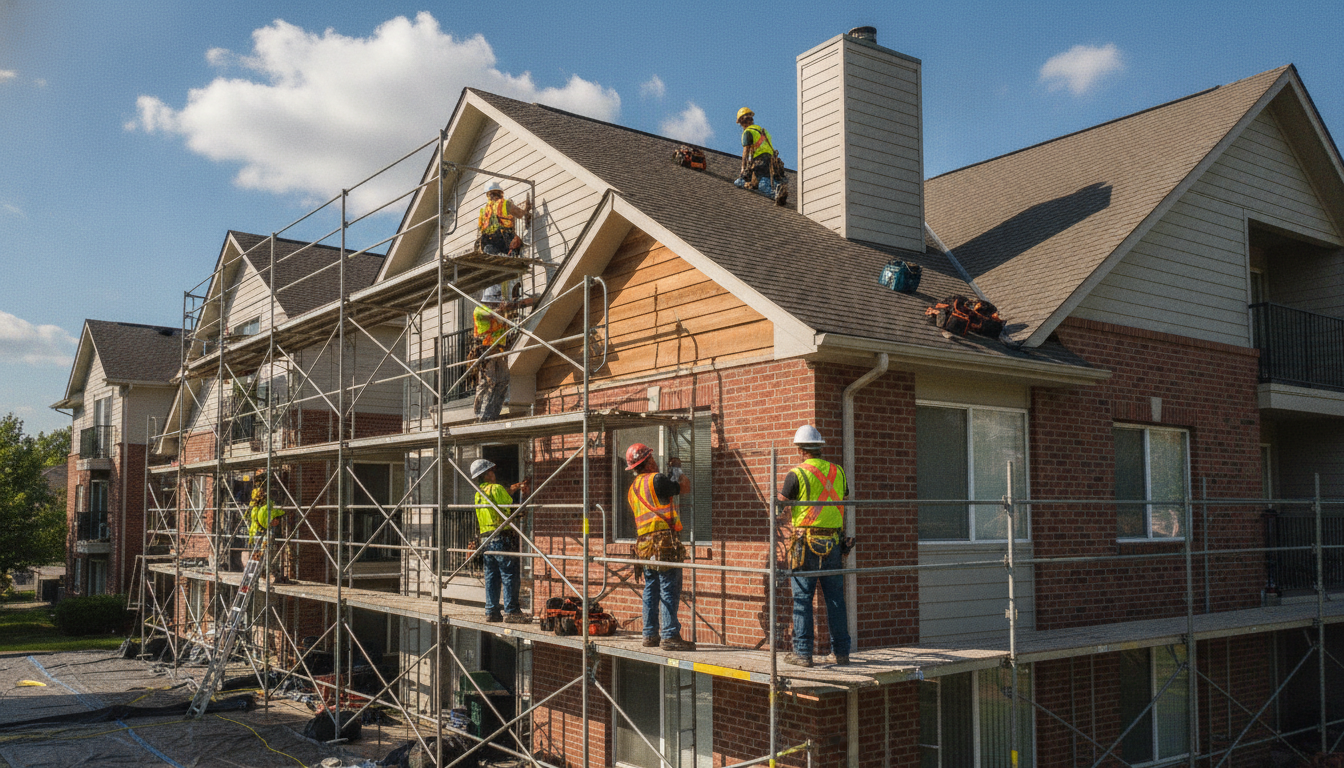
Severe weather events can trigger high master policy deductibles that boards divide among individual condo owners.
1. High Master Policy Deductibles
Due to rising weather claims and insurance inflation, many associations have accepted higher deductibles to keep monthly dues manageable. Condo master policies now frequently carry deductibles of $25,000, $50,000, or even $100,000.
Suppose a severe hailstorm destroys community roofs, resulting in $600,000 in covered damage. If the master policy has a $50,000 deductible and the complex contains 25 units, the board levies a $2,000 special assessment on each owner. A basic condo loss assessment coverage rider handles this expense directly.
2. Severe Property Damage Exceeding Policy Limits
If a major fire causes $5 million in damage to the building, but the HOA master policy carries a coverage cap of $4 million, an uninsured deficit of $1 million remains. In a 50-unit development, each owner receives a $20,000 assessment invoice. Having robust loss assessment coverage shields your family from this sudden debt.
3. Serious Common Area Liability Lawsuits
If a guest suffers a severe injury at the community swimming pool or icy staircase, a court might award a $3 million settlement. If association liability coverage caps out at $2 million, the remaining $1 million judgment becomes the collective legal liability of unit owners.
4. Water Damage in Shared Piping
Main water supply lines or plumbing risers passing between building floors can rupture, creating extensive structural damage. While owners frequently carry water backup coverage for sudden drain overflows inside their units, shared piping failures triggering building-wide repairs require loss assessment protection.
What Does Loss Assessment Coverage NOT Cover?
While loss assessment insurance provides critical defense, it is not a blank check for every HOA expense. Insurance carriers strictly distinguish between accidental property losses and regular maintenance.
- Routine Maintenance and Operating Deficits: If your board fails to budget properly for painting, landscaping, elevator servicing, or repaving, insurance will never reimburse that assessment.
- Gradual Wear and Tear: Structural components deteriorating over years from deferred maintenance do not qualify as insured peril events.
- Uncovered Perils: If a flood damages the clubhouse and the association lacked flood insurance through the National Flood Insurance Program, your personal endorsement will not pay without a specific flood assessment rider.
- Capital Improvements: Upgrading gym equipment, installing decorative lighting, or remodeling the lobby for aesthetic reasons cannot be claimed through insurance.
Loss Assessment Coverage Cost in 2026
One of the best aspects of HOA special assessment insurance is its exceptional affordability. The loss assessment coverage cost is among the most budget-friendly riders in the property insurance sector.
Most standard condo insurance (HO-6) policies bundle a default limit of $1,000 in loss assessment coverage. In today’s property market, $1,000 is rarely enough to cover a single deductible share. Fortunately, increasing this limit is remarkably inexpensive:
| Coverage Limit | Average Annual Cost (2026) | Recommended Property Profile |
|---|---|---|
| $1,000 | Included (Free default) | Rarely sufficient for modern HOA master deductibles |
| $10,000 | $15 – $25 per year | Small communities with modest amenities and low master deductibles |
| $25,000 | $25 – $40 per year | Mid-size condo complexes with swimming pools and elevators |
| $50,000 | $40 – $65 per year | High-rise towers or properties in coastal/storm-prone corridors |
| $100,000 | $65 – $110 per year | Luxury developments or complexes with high percentage deductibles |
For roughly $2 to $5 a month, raising your limit to $25,000 or $50,000 provides invaluable protection.
Real-World Example: How Loss Assessment Saved an Owner $14,000
Consider an owner named Sarah who purchased a two-bedroom unit in a 40-unit building in Denver. When setting up her insurance, she followed expert guidance and upgraded her default $1,000 loss assessment limit to $25,000 for an extra $28 per year.

Reviewing your HOA annual insurance declaration and master policy deductibles is the first step in sizing your coverage.
Three years later, an intense winter freeze burst multiple fire sprinkler mains in the attic above top-floor units, causing $800,000 in building damage. The HOA master policy covered the repairs, but carried a $100,000 master deductible. Furthermore, rebuilding required municipal code updates demanding ordinance or law coverage endorsements for new fire systems, leaving an additional $500,000 shortfall.
The board divided the $600,000 deficit across 40 owners, resulting in a special assessment of $15,000 per homeowner.
Sarah submitted the assessment invoice to her insurer. Because she carried $25,000 in loss assessment coverage, her carrier paid $14,500 after applying her $500 personal deductible. Her neighbors who had kept only the base $1,000 limit were forced to pay $14,000 directly out of pocket.
How Much Loss Assessment Coverage Do I Need?
Determining how much loss assessment coverage do I need requires reviewing specific association records rather than guessing. Follow these practical steps:
- Examine the HOA Master Policy Declaration Page: Request the current certificate of insurance from your property manager. Check the property deductible, wind/hail deductible, and general liability limits. If the deductible is $50,000 across 20 units, your minimum exposure is $2,500.
- Check for Percentage Deductibles: In coastal or storm regions, master policies often have percentage deductibles (such as 2% to 5% of total building value). A 3% deductible on a $20 million complex equals $600,000 in total community exposure.
- Review Association Reserves: A well-funded reserve study absorbs minor shortfalls without levying special assessments. Underfunded reserves mean higher assessment risk.
- Verify Sub-Limits for Master Deductibles: Some carriers cap payments for master policy deductibles at $1,000 or $2,500, even with a $50,000 overall limit. Always verify that your policy covers master deductibles up to your chosen limit.
For more details on structuring your property policy, explore our guide on condo insurance options and master policy guidelines, and learn how equipment breakdown coverage protects key appliances.
Loss Assessment Endorsement Checklist
Before purchasing or renewing, review these essential criteria recommended by the Insurance Information Institute and state regulators at the National Association of Insurance Commissioners:
- Endorsement Limit: Minimum $25,000 for standard condos; $50,000 or more for older buildings or high-rises.
- Master Deductible Clause: Ensure deductible assessments are covered up to the full limit without restrictive caps.
- Covered Perils: Confirm coverage applies to all primary policy perils (fire, wind, hail, lightning, explosion, and accidental water discharge).
- Liability Protection: Confirm the endorsement covers shared liability lawsuits in addition to physical property damage.
Frequently Asked Questions About Loss Assessment Coverage
Does loss assessment coverage have its own deductible?
Generally, your personal insurance deductible applies to a loss assessment claim. If your special assessment is $5,000 and your deductible is $500, your carrier pays $4,500. You pay your deductible only once per claim event.
Can my HOA assess me for someone else’s unit damage?
Only if damage originates in common property or association bylaws mandate shared liability. If a neighbor has an isolated plumbing leak inside their unit, their personal insurance handles repairs rather than an association assessment.
Is loss assessment coverage available for single-family homes?
Yes. If you own a single-family home in an HOA community with shared facilities like private roads, clubhouses, or gates, you can add loss assessment coverage to your standard HO-3 homeowners policy.
What happens if the HOA board did not buy enough insurance?
If master policy limits are exhausted during a catastrophic event, the association assesses owners to cover the shortfall. Your loss assessment endorsement pays your share up to your limit for covered perils.
Protect Your Savings Before the Next Assessment Arrives
Special assessments can arrive without warning, turning predictable housing expenses into urgent emergencies. Because loss assessment protection costs only a few dollars each month, increasing your coverage is one of the smartest decisions any condo or HOA homeowner can make in 2026.
Review your policy declarations and request a copy of your HOA master policy today. Verify your current loss assessment limit, and ensure you have sufficient protection in place before the next storm arrives.